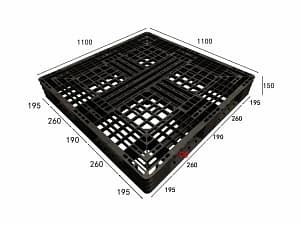
Presswood pallet ISPM 15 requirements are an important consideration for manufacturers, exporters, and international logistics companies. One of the main advantages of molded wood pallets is that pallets made entirely from qualifying processed wood materials are generally exempt from the treatment and marking requirements of ISPM 15.
However, not every pallet marketed as a presswood pallet automatically qualifies for this exemption. Its material composition, manufacturing process, construction, and destination-country requirements must all be considered.
This guide explains the international standard, the processed-wood exemption, mixed-material pallet risks, and the practical documentation exporters should prepare before shipping goods internationally.
1. Do Presswood Pallets Need ISPM 15?
In general, presswood pallets manufactured wholly from processed wood material are exempt from ISPM 15 treatment and marking requirements.
The International Plant Protection Convention (IPPC), through its International Standard for Phytosanitary Measures No. 15, specifically exempts wood packaging made wholly from processed wood materials.
Examples include:
- Plywood.
- Particle board.
- Oriented strand board (OSB).
- Veneer-based processed materials.
These materials are manufactured using glue, heat, pressure, or a combination of these processes.
The relevant provision is Section 2.1 of ISPM 15.
Official reference:
IPPC – ISPM 15: Regulation of Wood Packaging Material in International Trade. ippc.int
A molded wood pallet manufactured from wood fibers or chips combined with adhesive and formed under heat and pressure may fall within this processed-wood exemption when the entire pallet meets the relevant material definition.
This means the exemption is based on the nature of the finished product, not simply on the name of the pallet or the fact that it has been heated.
2. Why Are Molded Wood Pallets Different from Solid Wood Pallets?


The main difference is the material structure.
Traditional wooden pallets are normally assembled from solid timber boards, blocks, and stringers. These components can carry wood-boring insects and other quarantine pests.
ISPM 15 regulates wood packaging material made from raw wood because it can provide a pathway for the international spread of harmful pests.
Molded presswood pallets are manufactured differently.
Instead of assembling individual solid wood components, manufacturers process wood fibers, sawdust, or other qualified wood residues with an adhesive system and form the material into a finished pallet using heat and pressure.
The resulting product is a processed composite material.
| Feature | Solid wood pallet | Fully processed presswood pallet |
|---|---|---|
| Main construction | Assembled timber | Molded wood composite |
| Individual timber boards | Usually yes | No |
| Nails and fasteners | Common | Generally unnecessary |
| Manufacturing process | Cutting and assembly | Adhesive mixing and hot pressing |
| ISPM 15 treatment | Generally required when in scope | Generally exempt under the processed-material provision |
| ISPM 15 marking | Required when in scope | Not required under the exemption |
The important qualification is that the pallet must be made wholly from qualifying processed material.
A product combining molded wood sections with untreated solid timber blocks cannot automatically claim the same exemption.
3. What Types of Materials Can Be Used to Manufacture Presswood Pallets?

One of the advantages of presswood pallet manufacturing is the possibility of using different waste materials.
Common raw materials include:
| Raw material | Potential application |
|---|---|
| Wood sawdust | Molded wood pallet production |
| Wood chips | Composite pallet production |
| Wood shavings | Molded pallet production |
| Rice husks | Agricultural residue utilization |
| Wheat straw | Fiber-based pallet production |
| Hemp stalks | Agricultural fiber pallet production |
| Coconut fiber | Alternative biomass applications |
| Palm residues | Agricultural waste recycling |
| Flax residues | Fiber-based molded products |
Not all these materials have identical processing characteristics.
Each material must be evaluated for:
- Moisture content.
- Particle size.
- Fiber length.
- Bulk density.
- Adhesive compatibility.
- Material flow during mold filling.
- Finished pallet strength.
For example, long agricultural fibers may behave differently from conventional wood sawdust during mixing and mold filling.
The production recipe should therefore be developed through material testing rather than copied directly from another factory.
For more information, see PalletsBiz’s presswood pallet production process.
4. Does High Temperature Automatically Make a Pallet ISPM 15 Exempt?
No.
This is an important distinction that is often misunderstood in international pallet marketing.
ISPM 15 does not say that every pallet exposed to high temperatures and high pressure automatically becomes exempt.
The processed-wood exemption refers to wood packaging made wholly from qualifying processed wood materials, such as plywood, particle board, OSB, and veneer-based materials created using glue, heat, or pressure.
Therefore, the following statements are not equivalent:
- The pallet has been exposed to high temperature.
- The pallet has been manufactured from processed wood material.
- The pallet qualifies for the ISPM 15 exemption.
The third statement requires the appropriate product composition and construction.
For a manufacturer, it is important to document the entire production process and identify whether any untreated solid-wood components are incorporated into the finished pallet.
5. What Happens If a Presswood Pallet Contains Solid Wood Components?

This is one of the most important issues when evaluating export compliance.
Consider three different pallet configurations.
Configuration A: One-piece molded wood pallet
The entire pallet is manufactured from processed wood fibers and adhesive through a molding process.
If the complete product meets the processed-wood definition, the ISPM 15 exemption generally applies.
Configuration B: Molded deck with solid wood support blocks
The pallet combines a processed wood deck with separate solid timber blocks.
The pallet is no longer made entirely from processed wood material.
The solid wood components must be evaluated under the applicable phytosanitary requirements.
Configuration C: Traditional wooden pallet with some processed wood components
The use of plywood or another processed material in part of a pallet does not automatically exempt the remaining solid-wood packaging components.
ISPM 15 also contains specific requirements for repaired and remanufactured wood packaging. For example, the standard addresses the use of treated wood or processed wood materials when components are replaced. ippc.int
For international shipments, the safest approach is to confirm the complete product construction with the relevant importing-country authority or customs broker.
6. What Do the United States and United Kingdom Say About Processed Wood Packaging?
Different national authorities publish guidance explaining the distinction between solid wood packaging and processed alternatives.
The United States Department of Agriculture’s Animal and Plant Health Inspection Service (APHIS) explicitly identifies several alternatives that are not subject to its wood packaging material regulation.
These include:
- Plywood or pressboard.
- Plastic pallets.
- Oriented strand board.
- Hardboard.
- Parallel strand lumber.
- Synthetic foam.
- Metal frames.
Official reference:
USDA APHIS – Import ISPM 15-Compliant Wood Packaging Material. APHIS
This is particularly relevant to exporters shipping goods to the United States.
United Kingdom: Wood Packaging Material Guidance
The UK government also explains that its wood packaging material rules do not apply to processed, non-solid wood packaging such as plywood, as well as certain other exempt materials.
Official reference:
UK Government – Wood Packaging Material for Import and Export. GOV.UK
These references support the commercial value of processed wood pallets in international logistics.
However, exporters should distinguish phytosanitary exemptions from other requirements governing packaging, product safety, customer specifications, and customs documentation.
7. China’s GACC Order 283 and Its Relevance to Wood Packaging
China’s General Administration of Customs issued Order No. 283 on April 27, 2026.
The order came into force on November 1, 2026.
It amended seven customs inspection and quarantine regulations, including rules governing imported and exported wood packaging material.
The amendments include changes to the qualification period for authorized wood packaging treatment and marking businesses, which increased from three to five years, and adjustments to the supervision and penalty provisions.
The revised imported wood packaging rules also explicitly exclude deeply processed materials such as plywood, particle board, and fiberboard from their definition of regulated wood packaging material.
Official source:
China’s GACC Order No. 283 – Ministry of Commerce. 商务部+2
It is important to understand that this is a Chinese domestic regulatory amendment, not a replacement of the international ISPM 15 standard.
For presswood pallet manufacturers, the most relevant point is the continued regulatory distinction between raw solid wood packaging and deeply processed wood packaging.
8. What About the New French TRACES Requirements?
France introduced additional controls from September 1, 2026, for certain wood packaging material accompanying consignments of sanitary and phytosanitary goods.
The requirements involve the TRACES system and additional declarations for relevant wood packaging.
The Czech Republic’s official plant-health authority explains that the requirement applies to untreated or raw wood packaging material exceeding 6 mm in thickness, including pallets and crates.
It is not a universal requirement covering every pallet shipment entering the European Union. ÚKZÚZ
The UK Department for Environment, Food & Rural Affairs also published guidance on September 16, subsequently updated November 3, explaining the French enforcement measures.
It states that exporters remain responsible for ensuring regulated wood packaging meets the applicable ISPM 15 requirements. GOV.UK
For manufacturers of molded wood pallets, the distinction between fully processed wood packaging and regulated solid wood packaging remains important.
However, when exporting to France or other markets with specific requirements, the exporter should obtain confirmation of the applicable product classification and shipment documentation.
9. What Documents Should Presswood Pallet Manufacturers Prepare?
Even when a finished pallet qualifies for the processed-wood exemption, maintaining technical records is a good business practice.
A manufacturer should consider preparing the following documents.
| Document | Purpose |
|---|---|
| Raw material specification | Identify the materials used |
| Product composition declaration | Explain the finished pallet structure |
| Manufacturing process description | Document the processing method |
| Adhesive specification | Identify the bonding system |
| Product drawings | Show pallet structure and construction |
| Product photographs | Demonstrate the molded design |
| Quality inspection report | Document finished product consistency |
| Destination-specific compliance confirmation | Support the export transaction |
These documents are recommended technical evidence, not a substitute for an official regulatory determination or a certificate issued by an authorized authority.
A clear product description can help importers, customs brokers, and logistics companies distinguish a one-piece molded pallet from conventional solid wood packaging.
For machinery manufacturers, this also creates an opportunity to provide customers with a complete production documentation package.
10. How Does Presswood Pallet Manufacturing Support Export Logistics?

The advantages of molded wood pallets go beyond phytosanitary requirements.
Their one-piece construction and nestable designs can also provide practical benefits.
Space-efficient transportation
Nestable pallets can be stacked together, reducing the volume required for empty pallet storage and transportation.
The actual savings depend on the pallet dimensions, nesting geometry, and stacking height.
No nails or separate assembly components
A one-piece molded structure eliminates the need for conventional nails and separate timber assembly.
This can simplify handling and reduce certain maintenance issues.
Waste material utilization
Wood waste and suitable agricultural residues can be converted into valuable logistics products.
This may help manufacturers reduce dependence on purchased solid timber, depending on local material availability and production economics.
Integrated manufacturing
A complete presswood pallet production line can include:
- Raw material crushing.
- Material drying.
- Adhesive mixing.
- Material weighing and spreading.
- Hydraulic hot pressing.
- Automatic demolding.
- Conveying and stacking.
The press and mold should be designed according to the actual pallet dimensions, material characteristics, and required output.
For manufacturers evaluating this investment, explore ZK Hydraulic’s presswood pallet machine range and custom pallet mold manufacturing.
11. Frequently Asked Questions
Q1: Are presswood pallets exempt from ISPM 15?
Generally, yes, when the entire pallet is made from qualifying processed wood material under Section 2.1 of ISPM 15.
Q2: Do presswood pallets need an IPPC mark?
A pallet qualifying for the processed-wood exemption does not require the ISPM 15 treatment mark under that standard.
Q3: Can a molded pallet contain solid wood blocks and still be exempt?
Do not assume so. The standard’s exemption requires the wood packaging material to be made wholly from processed wood material. Solid wood components need separate evaluation.
Q4: Are rice husk and agricultural fiber pallets automatically exempt?
Not automatically. Their finished construction and material processing must be evaluated against the applicable processed-wood definition and destination-country rules.
Q5: Does the United States accept pressboard pallets without ISPM 15 treatment?
USDA APHIS identifies plywood and pressboard among alternatives that are not subject to its wood packaging material regulation. The specific finished product must still meet the relevant classification requirements.
Q6: Does high-temperature molding replace fumigation?
For a qualifying fully processed wood packaging product, ISPM 15 treatment is generally not required because of the processed-material exemption. This should not be confused with a general rule that any heated wooden pallet is automatically exempt.
Q7: Does GACC Order 283 change the international ISPM 15 standard?
No. It amends Chinese customs inspection and quarantine regulations. ISPM 15 remains the international reference standard for regulated wood packaging material.
Conclusion
Presswood pallet ISPM 15 exemption is an important advantage for manufacturers and exporters, but it must be understood correctly.
The key requirement is that the finished wood packaging must be made wholly from qualifying processed wood material.
A one-piece molded wood pallet manufactured using wood fibers, adhesive, heat, and pressure can generally qualify for this exemption. However, pallets containing solid wood components require additional evaluation.
For manufacturers, maintaining accurate product specifications, material records, and manufacturing documentation is essential.
For buyers, confirming the actual pallet construction is more important than relying on a supplier’s marketing description.
At ZK Hydraulic, presswood pallet production solutions combine hydraulic press engineering, customized mold manufacturing, and raw material processing to help customers turn suitable wood waste and agricultural residues into finished molded pallets.
Explore ZK Hydraulic’s presswood pallet machines and PalletsBiz’s presswood pallet product range to learn more about the manufacturing solutions.