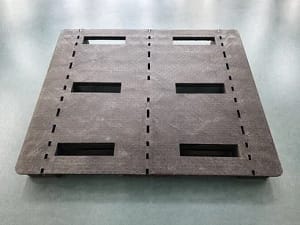
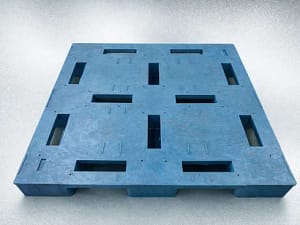
On day one in Shanghai, molded pallet feasibility pushed price off the table. Material viability, pressability, call it what you like. Buyers from eight export markets asked whether their own fiber could carry a load-rated pallet. Hemp stalk, reed, flax, coir, rice husk and peanut shell all came up. So did bio-based glue.

Molded pallet feasibility, not price, set the agenda on day one of CeMAT ASIA 2026. The show runs 3–6 November at the Shanghai New International Expo Centre. The official CeMAT ASIA factsheet lists more than 900 exhibitors, over 80,000 m² of floor space and 140,000 expected buyers. At Booth W5-D4-3, our team met domestic Chinese customers. Buyers also came from India, Southeast Asia, Mexico, Brazil, Russia, Spain, Germany and the Netherlands. Nobody opened with a quotation request.
Molded pallet feasibility is proof that a named fiber and a named binder can press a load-rated pallet. Weight, load and cycle time must hold on a production press. That proof comes as a test report, not a price list. The order matters. Once a buyer accepts that the project is technically possible, the budget conversation becomes an internal formality. The real negotiation moves to recipe, mold and line layout.
Molded Pallet Feasibility Replaced the Price Question
We saw the start of this at the 140th Canton Fair in October. There, buyers arrived with photos of waste piles. In Shanghai they brought the material itself, or a description precise enough to specify fiber length and moisture. Hemp stalk, reed, flax straw, coir fiber, rice husk and peanut shell all landed on the same table. Each one needed a different answer on drying, particle size and binder ratio.
Eight signals stood out on the floor. No opening price questions. Samples instead of brochures. Eight export markets in one morning. Six unrelated feedstocks on one table. Bio-adhesive requests. Hard spec questions on recycled plastic. Requests to mail adhesive to our factory. And a willingness to discuss trial runs before anyone talked configuration. Every one of them points at molded pallet feasibility. None of them is about capex.
“In earlier years the first question was what a machine cost,” one of our engineers said on the stand. “This year it is whether the fiber stacked in their yard can carry a pallet. That tells you the decision was made upstream, before they flew to Shanghai.” We would put it less politely. A buyer who has already cleared the technical risk is not shopping for a discount.
Our reading of why is unromantic. A 2026 market study puts the global presswood pallet market at US$3.4 billion this year and US$5.1 billion by 2033. That is a 6.1% CAGR, with Asia Pacific taking about 37.3% of demand and nestable formats holding 62.6% of the product mix. Growth like that, in a category this unglamorous, is not speculation. It is procurement departments quietly rewriting specifications. That is why molded pallet feasibility has become a procurement question, not an engineering one.
The technical baseline those buyers aim at is equally plain. Our presswood pallet machine range runs from 1,000 to 3,000 tons, and molding happens at 180–220°C. A standard 1200 × 800 mm nine-foot pallet leaves the press at 11.5–14.0 kg and carries a 1,000–1,500 kg dynamic load. Hitting those numbers with rice husk instead of sawdust is a formulation problem, not a sales problem.
Bio-Adhesives Put Molded Pallet Feasibility to the Test
Adhesive choice was the second front. MDI remains the reference binder for molded pallets, and most installed lines are built around it. Several visitors asked about bio-based adhesives instead, driven by sustainability targets and, in a few cases, by requirements handed down from their own customers. There is a problem with that request. Bio-based binders have almost no precedent in pallet production and very few published cases to point at. Bio-glue turns molded pallet feasibility into a chemistry problem. We are not going to promise a bond strength we have not measured.
So we asked them to mail adhesive samples to our plant in Henan. We will test cure behavior, bond strength, water resistance and fiber compatibility. The trials run on the same press the production line uses. Then we report the numbers back. A pallet has to survive a warehouse, a truck and a rainy loading dock. That is where a binder either works or it does not.
Regulation is pushing the same way. The EU Packaging and Packaging Waste Regulation has applied since 12 August 2026. An industry association briefing published on 19 October 2026 sets out the documentation and traceability duties now falling on packaging suppliers. Binder choice is becoming a paperwork question as much as a chemistry one. Separately, the ISPM 15 text from the IPPC exempts wood packaging made wholly of processed wood material created using glue, heat or pressure. That exemption is why a molded pallet crosses a border without a heat-treatment stamp. Eight export markets in one morning is exactly who cares about it.

Recycled Plastic Pallets: Molded Pallet Feasibility by the Numbers
The second exhibit on the stand was a pallet pressed from recycled plastic. Overseas buyers were blunt about what they wanted: weight per pallet, load capacity, and power consumed per pallet. Those three figures decide freight, payload and operating cost. They are also the three figures most suppliers leave vague.
We published our own trial figures in October. A four-core-pulling mold trial on a ZK-P1800 press produced a 1,300 × 1,100 mm pallet at about 23 kg from 100% mixed recycled plastic. Holding time was 60 seconds. Dynamic load came in around 2,000 kg and static load around 6,000 kg, measured with reference to ISO 8611 methods. Those are trial results for one material mix, not a certificate, and we say so plainly. Molded pallet feasibility, in the plastic version, is mostly arithmetic — arithmetic a buyer can check.
Power is the part that gets skipped. Servo-driven hydraulics on our plastic pallet machine cut consumption by 30–70% against conventional drives. That changes cost per pallet more than the sticker price of the press ever will. The product overview on palletsbiz.com covers the same 800–3,000 ton range for wood fiber. Two waste streams, one press platform, two sets of numbers to hand a buyer.
What to Bring to Booth W5-D4-3
Bring a sample, not a budget. Molded pallet feasibility starts with a bag of fiber, not a spreadsheet. We are at CeMAT ASIA through 6 November, and our engineers will look at fiber or adhesive on the stand before anybody discusses a line. If the material needs a press trial, mail it to the factory and we will send back a test report. Our contact page is the shortest route from a question to a trial.
The expensive mistake in this business is buying a press before you know your fiber. Today’s visitors seem to have worked that out for themselves. Molded pallet feasibility is where the money gets decided now, well before a quotation is written.