
New mold technology enables the production of high-load-capacity pallets from 100% mixed recycled plastics, opening new possibilities for difficult-to-recycle plastic waste.
Anyang, China — October 20, 2026 — ZK Hydraulic continues to invest in research and development focused on composite plastic materials and advanced pallet manufacturing technologies. The company has successfully developed a recycled plastic pallet mold featuring four core-pulling mechanisms and recently completed production trials using 100% mixed recycled plastic feedstock.
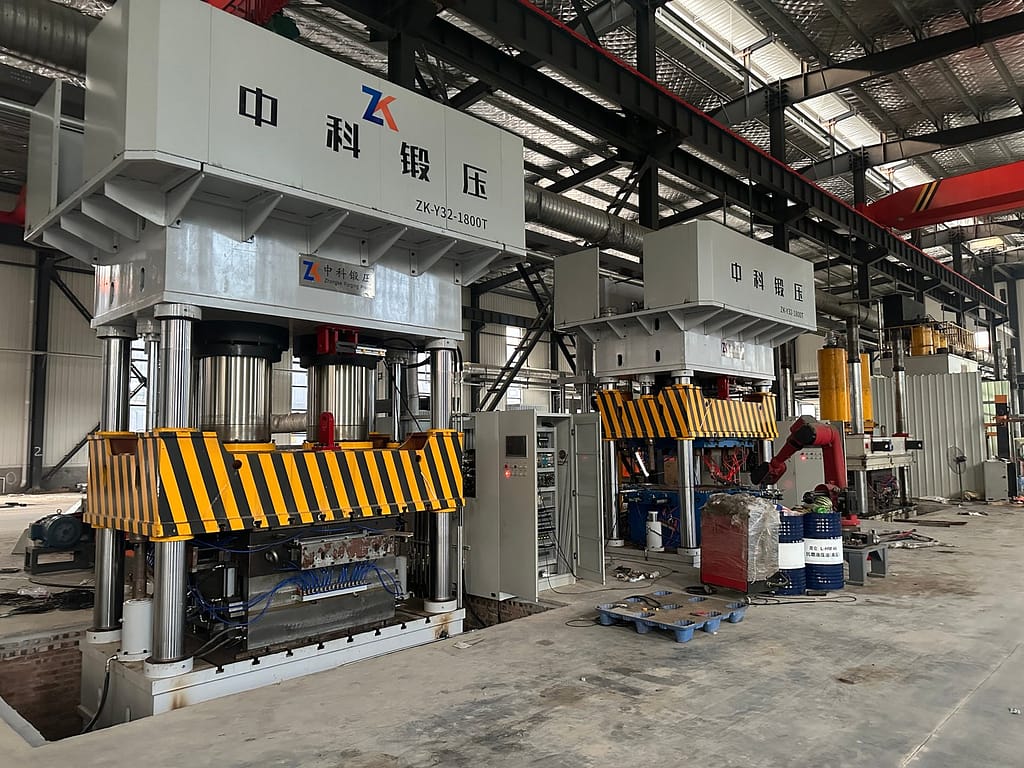
The trials demonstrate the potential of melt compression molding to transform complex plastic waste streams into durable, reusable industrial pallets, offering a new approach to plastic waste valorization and resource recovery.
Addressing the Challenge of Mixed Plastic Waste
Industrial production and municipal waste streams contain mixtures of different plastics, including polyethylene (PE), polypropylene (PP), polystyrene (PS), and polyethylene terephthalate (PET). Separating these materials can be costly, particularly when the recovered materials have relatively low market value.
Conventional waste management methods, such as landfilling and incineration, can also create environmental challenges when not properly managed. Developing practical technologies that convert mixed plastic waste into useful products is therefore an important opportunity for the recycling industry.
However, mixed plastics are not equivalent to a single, uniform polymer. Differences in melting behavior, polymer compatibility, viscosity, and mechanical properties can make conventional recycling and molding processes difficult to control. Traditional plastic pallet production typically relies on relatively well-defined material compositions and processing conditions.
ZK Hydraulic is exploring an alternative approach: combining melt compression molding with specially engineered molds to process suitable mixed recycled plastic feedstocks into industrial pallets.
Four-Core-Pulling Mold Technology for Advanced Pallet Production
The newly developed mold incorporates four core-pulling mechanisms designed to support the formation of complex pallet structures. Combined with a large-platen hydraulic press, this technology expands the possibilities for manufacturing recycled plastic pallets with integrated structural features.
According to ZK Hydraulic’s development and production trials, the combination of specialized mold engineering and melt compression molding offers several potential advantages:
- Improved structural performance: The mold design aims to produce pallets with a practical balance of stiffness, toughness, and load-bearing capability.
- Reduced product weight: Preliminary comparisons indicate that pallet weight can be reduced by approximately 20% compared with certain conventional molding processes, depending on the pallet design, material composition, and production conditions.
- Greater design flexibility: Specialized mold structures can support more complex pallet geometries and functional features.
- Improved material utilization: Suitable mixed recycled plastics can be converted directly into finished pallet products without necessarily requiring every polymer to be separated into an individual stream first.
Through continued mold development, ZK Hydraulic aims to bring compression-molded plastic pallets closer to the dimensional consistency and structural sophistication associated with injection-molded pallet designs, while maintaining the advantages of its own manufacturing process.
The company recognizes that performance depends on the specific feedstock and product design. Mixed plastics cannot be assumed to behave uniformly, and each material formulation must be evaluated under appropriate processing conditions.
Production Trial: 100% Mixed Recycled Plastics
In its latest production trial, ZK Hydraulic used its newly developed mold together with a ZK-P1800 large-platen hydraulic press to manufacture a pallet using 100% mixed recycled plastic material.
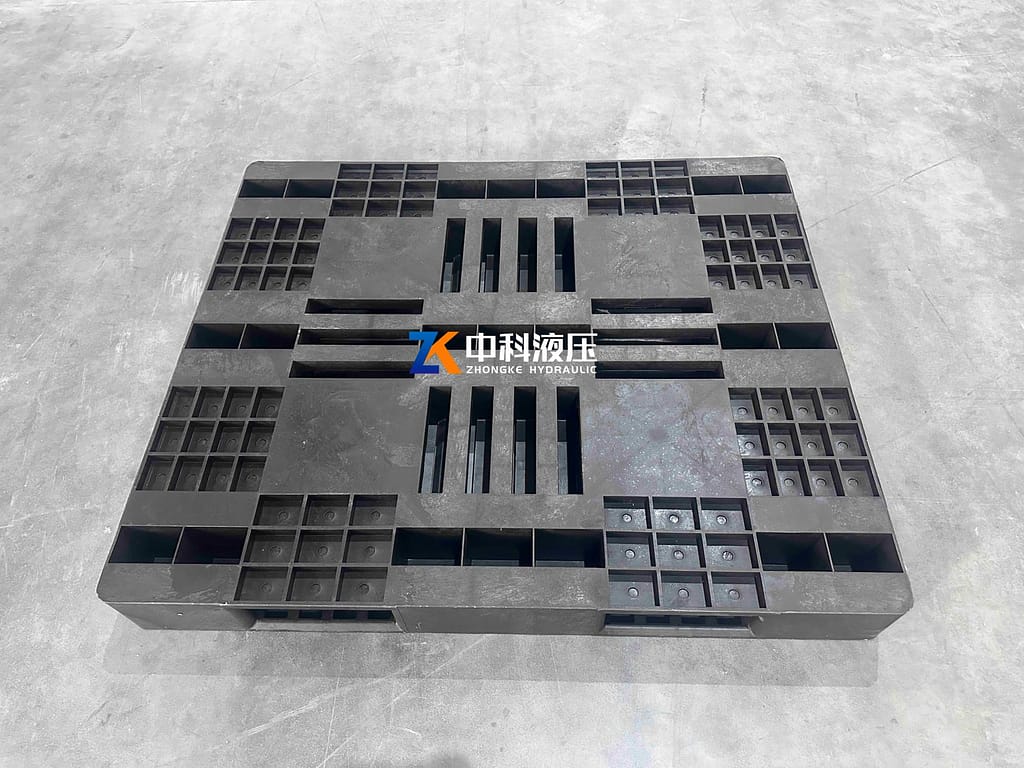
The trial produced the following preliminary results:
| Parameter | Trial result |
|---|---|
| Hydraulic press | ZK-P1800 |
| Mold technology | Four-core-pulling mold |
| Recycled material content | 100% mixed recycled plastics |
| Pallet dimensions | 1,300 × 1,100 mm |
| Approximate pallet weight | 23 kg |
| Holding time | 60 seconds |
| Reported dynamic load | Approximately 2,000 kg |
| Reported static load | Approximately 6,000 kg |
The reported load values were obtained from tests conducted with reference to ISO 8611 methods. They are preliminary results for the tested pallet and material configuration, rather than a claim of ISO certification or universal performance across all mixed plastic feedstocks.
These results indicate that compression molding may offer a promising route to producing industrial pallets from certain mixed recycled plastics that are challenging or uneconomical to separate for conventional recycling.
The reported 60-second holding time also provides a useful starting point for further evaluation of production efficiency. Actual cycle time and output will depend on heating, cooling, material preparation, mold configuration, and the required product specifications.
Why Material Testing Remains Essential
Despite the promising trial results, ZK Hydraulic emphasizes that not every mixed plastic feedstock is suitable for compression-molded pallet production.
Different polymers have different melting temperatures, thermal stability, flow characteristics, and compatibility. For example, PE and PP may behave differently from PS and PET under the same processing conditions. Contamination, moisture, additives, and variations in the proportions of individual polymers can further affect the finished product.
For this reason, ZK Hydraulic recommends conducting feedstock-specific trials before selecting the final production process and equipment configuration.
The company can evaluate customer-provided materials and assess key factors such as:
- Material composition and consistency
- Suitable processing temperatures and cycle parameters
- Mold design and pallet geometry
- Finished pallet weight and dimensional stability
- Dynamic, static, and other application-specific load requirements
For background on plastic selection and recycling, see ZK Hydraulic’s guide to common plastics used in plastic pallets and recycling.
European Waste Shipment Rules Create New Opportunities for Local Recycling
The development comes as regulatory changes are reshaping the international plastics recycling landscape.
Under the European Union’s Waste Shipment Regulation, the prohibition on exports of plastic waste to non-OECD countries is scheduled to apply from November 21, 2026. The new rules are intended to strengthen environmentally sound waste management and reduce reliance on exporting plastic waste to countries outside the OECD. Certain other waste-export restrictions have separate implementation dates and conditions.
For European recycling companies, these changes may increase the importance of developing effective domestic and regional processing capacity. They may also create additional demand for technologies capable of turning difficult-to-recycle plastic waste into commercially useful products.
However, increased local feedstock availability alone does not guarantee profitability. Recycling businesses must still address sorting costs, feedstock consistency, energy consumption, processing capacity, product quality, and market demand.
Industrial pallets offer one potential application for suitable mixed recycled plastics. Unlike applications requiring highly controlled material properties, some industrial pallet designs may accommodate selected mixed-polymer feedstocks when the process and mold are appropriately engineered and the finished products pass the required performance tests.
Official information on the regulatory framework is available from the European Commission’s waste shipment policy page.
From Plastic Waste to Industrial Pallets: An Integrated Solution
ZK Hydraulic provides integrated equipment and technical support for industrial molded plastic pallet production projects. Depending on the customer’s feedstock and production requirements, a solution can include:
- Plastic shredding and size reduction
- Material feeding and handling
- Hydraulic compression molding
- Customized pallet molds and core-pulling systems
- Production trials and finished-product testing
- Operator training, commissioning, and after-sales support
By combining material evaluation, hydraulic press technology, and customized mold engineering, ZK Hydraulic aims to help recycling companies develop commercially viable applications for suitable mixed recycled plastics.
Customers interested in evaluating this technology can learn more about the company’s plastic pallet compression molding machine solutions.
Looking Ahead
The successful trial using 100% mixed recycled plastics represents a further step in ZK Hydraulic’s ongoing research into composite recycled materials and industrial pallet manufacturing.
As recycling regulations evolve and businesses seek higher-value applications for difficult-to-recycle plastics, advanced compression molding may provide an additional route for converting selected waste streams into durable industrial products.
ZK Hydraulic welcomes inquiries from plastic recyclers, waste management companies, and industrial pallet manufacturers interested in testing their own materials and evaluating customized production solutions.
About ZK Hydraulic
ZK Hydraulic specializes in the research, development, and manufacture of molded pallet machinery, recycled plastic pallet production equipment, and customized mold systems. The company provides technical support across material testing, equipment configuration, mold development, production commissioning, operator training, and after-sales service.
For more information, visit PresswoodMachine.com.


