
Two numbers landed in Europe this month, ten days apart, and together they explain why so many recycled plastic pallet projects are being re-underwritten right now.
The first came from Eurostat on 22 October: the EU generated 81.5 million tonnes of packaging waste in 2024, plastic made up 19.9% of it, and the bloc recycled 42.4% of its plastic packaging — up barely a point from 41.6%. The second came from the Bureau of International Recycling’s plastics division, which described the European recycling market as “bleak,” confirmed a continuation of the capacity closures that have run since 2023, and noted that PE and PP recyclate prices are flat to slightly down on subdued demand.
Read those together and you get a contradiction that matters to anyone planning a pallet plant. Regulation is pushing recycled content up. The industry that supplies recycled content is shrinking. And the price of the material everyone assumed would become scarce has, for now, gone the other way.
That changes what a pallet line should be buying. Not the machine — the feedstock.
The margin that made the old case work is gone
Through 2022 and 2023 the recycled plastic pallet pitch was simple arithmetic. Recyclate traded at a discount to virgin resin, sometimes a wide one. You bought regrind or pellets cheap, pressed it into pallets, and sold at 60–70% of the price of an injection-moulded pallet, because your tooling was a single steel mould instead of a 1,500-tonne injection cell. The spread paid for the press.
By August 2026 that spread had collapsed. ICIS data cited by Plastics Recyclers Europe put the virgin-to-recycled HDPE gap at roughly €125 per tonne, down from €1,140 per tonne earlier in the cycle. When the price of rHDPE is within 10% of virgin, the buyer has no reason to accept the colour variation, the odour, the batch-to-batch drift. They buy virgin and stop taking calls. European recyclers closed plants against that reality — around a million tonnes of capacity lost in three years, with industry sales down 5.5% in 2024.
So here is the uncomfortable conclusion for anyone whose business plan says buy recyclate, press pallets, undercut the injection guys: your raw material is no longer cheap, and the person selling it to you is going out of business.

What actually separates a line that makes money
The lines that are still running profitably in 2026 are not the ones that found the cheapest pellets. They are the ones that never buy pellets at all.
Which brings us to the definition worth pinning down, because most buyers get it backwards.
Compression moulding of recycled plastic pallets is a one-shot process: shredded, un-pelletised plastic waste is dosed into a heated steel mould and formed under 800–2,000 tonnes of clamp force for 60–180 seconds, producing a finished pallet directly from flake or agglomerate. Its defining property is not tonnage. It is impurity tolerance. There is no nozzle to block, no melt filter to change, no pellet specification to hit, and no viscosity grade to match.
That single property is what the price inversion just made valuable. When pellets were cheap, tolerance didn’t matter — you could buy a clean, consistent, documented grade and compete on machine cost. When pellets cost nearly what virgin costs, the only material with a genuine cost advantage is the material nobody else can use: mixed rigid, cable skin, film bales, textile waste, shredder residue. That material has no pellet market. It has a disposal cost.
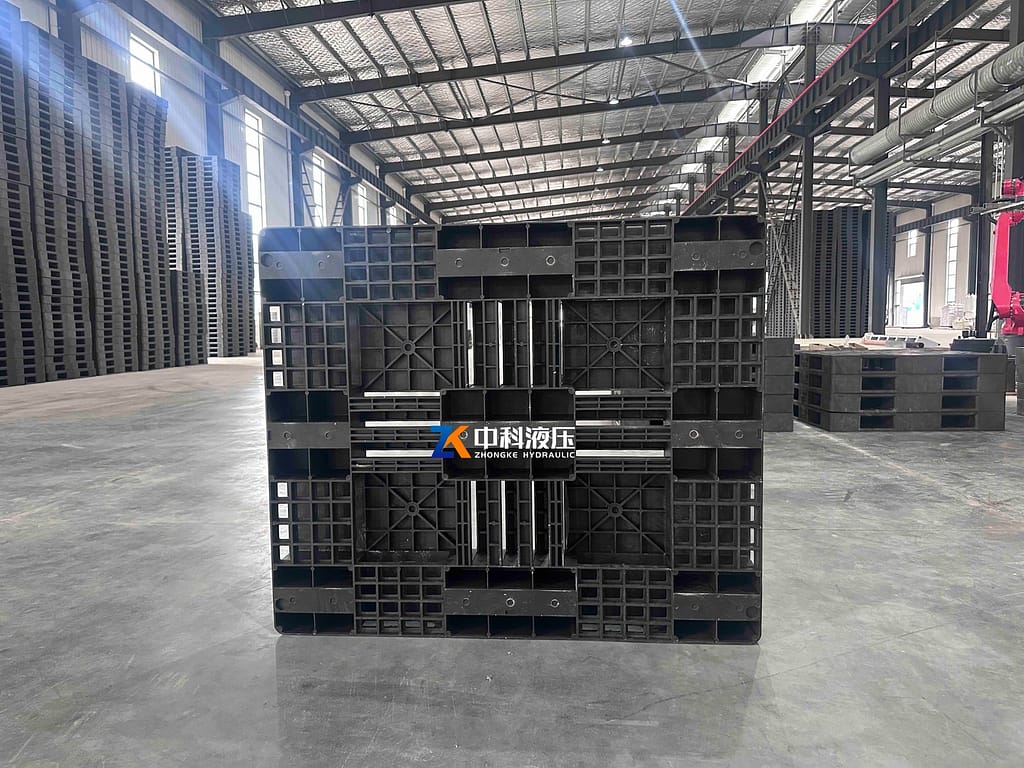
We ran a trial on exactly that in October. A 1,300 × 1,100 mm pallet, 100% mixed recycled plastics with no separation step, pressed on a ZK-P1800 with a four-core-pulling mould: 23 kg finished weight, 60-second holding time, roughly 2,000 kg dynamic and 6,000 kg static load, measured against ISO 8611 methods. Preliminary numbers for one material configuration, not a universal claim. But they describe a pallet that competes on load with a moulded wood pallet, made from a feedstock that most recyclers would rather landfill than sort. Details of that trial are on our palletsbiz project notes.
The feedstock hierarchy, ranked by what actually pays
Not all waste plastic is equal in front of a press, and the ranking has almost nothing to do with polymer type.
Tier one: streams you already own, or get paid to take. Cable strippers, textile cutters, paper mills with film waste, appliance dismantlers. Your cost basis is negative — you were paying a licensed operator to remove this material. Every pallet pressed from it is a pallet you don’t buy and a disposal fee you don’t pay. This is the only tier where the economics are robust at today’s resin prices, and it is why recyclers and manufacturers with an in-house waste stream are the most natural pallet producers in the world.
Tier two: mixed post-consumer rigid. PE, PP, PS and a little PET, baled and shredded but not separated. Works in compression moulding because the process doesn’t demand a single melt index. Fails in injection moulding for the same reason. Your cost is the baler’s price plus freight, and freight into Europe is soft — Far East to North Europe spot rates were 29% below their 1 July level by late September.
Tier three: washed, pelletised rHDPE or rPP. This is where projects die in 2026. You are buying a commodity that competes directly with virgin at a €125 spread, and you are competing for it against brand owners who need it to hit a legislated recycled-content number. Unless your pallet has to be food-contact clean, stay out of this tier.
There is a fourth category that keeps coming up in enquiries: heavily contaminated film and printed laminates. Sometimes it presses. Sometimes it delaminates in the mould and you get a pallet with a weak core that passes a static test and fails in month eight. This is not a machine question. It is a trial question.
Where the demand is coming from, and why it isn’t the premium end
The pallet market itself is not the constraint. Value Market Research puts plastic pallets at USD 12.84 billion in 2026, heading to USD 20.25 billion by 2034 at a 5.86% CAGR, with nestable formats holding 42.3% of 2025 revenue and rackable growing fastest at 8.56%. HDPE is 69.8% of the material mix.
The regulatory pull is real, and it is specific. PPWR names pallets directly in Article 29(1) as transport packaging, which puts them inside the reuse targets: 40% of covered transport packaging reusable by 1 January 2030, and a full 100% for movements between a company’s own sites and deliveries within the same Member State. Article 7 adds recycled content — 35% for non-contact-sensitive plastic packaging from 2030, 10% if the pallet is classified contact-sensitive. Averaged per plant, per year, per format, not per unit.
What that produced in the market this month was a premium product, not a commodity one. Tosca and Cabka launched the CP1208 at Fruit Attraction in Madrid on 8 October — a 1200 × 800 mm euro pallet in 100% recycled plastic, over 4 kg lighter than its wooden equivalent, with RFID and integrated deck grooves. Packaging Europe’s write-up frames it exactly as you’d expect: a pooling asset for automated fresh-produce lines, sold on hygiene, traceability and PPWR readiness.
That is a different business from yours. Pooling players serve the closed-loop, high-cycle, brand-audited end of the market with injection-moulded assets and a service contract attached. The volume end — the factory that needs 40,000 one-way or light-return pallets a year and cannot justify a €2 million injection cell — is still served by compression moulding, and increasingly by producers who own their waste stream. Both can be true at once. They are not competing for the same purchase order.
What to ask before you sign for a line
The spec conversation has shifted, and most quotations haven’t caught up.
Ask what contamination level the line tolerates, in writing, with the measurement method named — ash content, moisture, residual metal, fibre fraction. Ask what happens to cycle time as contamination rises, because a 60-second hold on clean flake becomes 110 seconds when the material is damp, and your output model just halved. Ask whether the mould can be swapped for a different footprint without changing the platen, because your first customer will want 1200 × 800 and your second will want 1300 × 1100. And ask for a trial on your material before a price — a supplier who quotes a payback period on material they have never pressed is guessing with your capital.
The tonnage number matters less than the market suggests. Catalogue listings circulating this month for solid-waste plastic pallet presses quote an 800T and 1,000T model at 55 kW, a 120-second cycle and 20 pallets an hour — numbers that don’t reconcile, which usually means sales wrote the spec sheet and not the process engineer. A 1,000-tonne press with a bad mould and wet material will out-perform nothing.
Our own configuration work has gone in the other direction: a dual-station recycled plastic pallet press that forms two pallets per cycle on one frame, which is how you get output without adding a second press, a second operator and another 400 m² of floor. The full specification range is on our plastic pallet machine page — read it with your feedstock in hand, not as a price list. For plants that also have wood or agricultural fibre waste, the same platform runs presswood pallets with a mould change, so one building carries two feedstock streams and two product lines.
The bet worth making
Here is the honest position. Recycled-content regulation will eventually make recyclate valuable again — but the BIR’s own read is that the 2030 targets are too far away to rescue order books in 2026, and the recyclers closing this year will not all reopen. Between now and then, the material that pays is the material with no alternative buyer.
That argues for a plant built around a waste stream you control, not around a resin price you don’t. It argues for compression moulding over injection, because tolerance for impurity is now the whole margin. And it argues for testing your material before you test your business plan.
Current capacity data, trial results and project notes are on our news page. If you have a waste stream and a pallet requirement, send us a 20 kg sample — we’ll press it and send back the numbers, including the ones that argue against the project. That report is worth more than any quotation. Start with the material.


