
Your pallet passes the static test in the yard. It carries the load, survives the forklift, looks the part. Then it enters the automated warehouse and the stacker crane starts throwing fault codes. Nobody reset the pallet spec when the warehouse went automated — and that gap is where most recycled plastic pallet projects quietly fail.
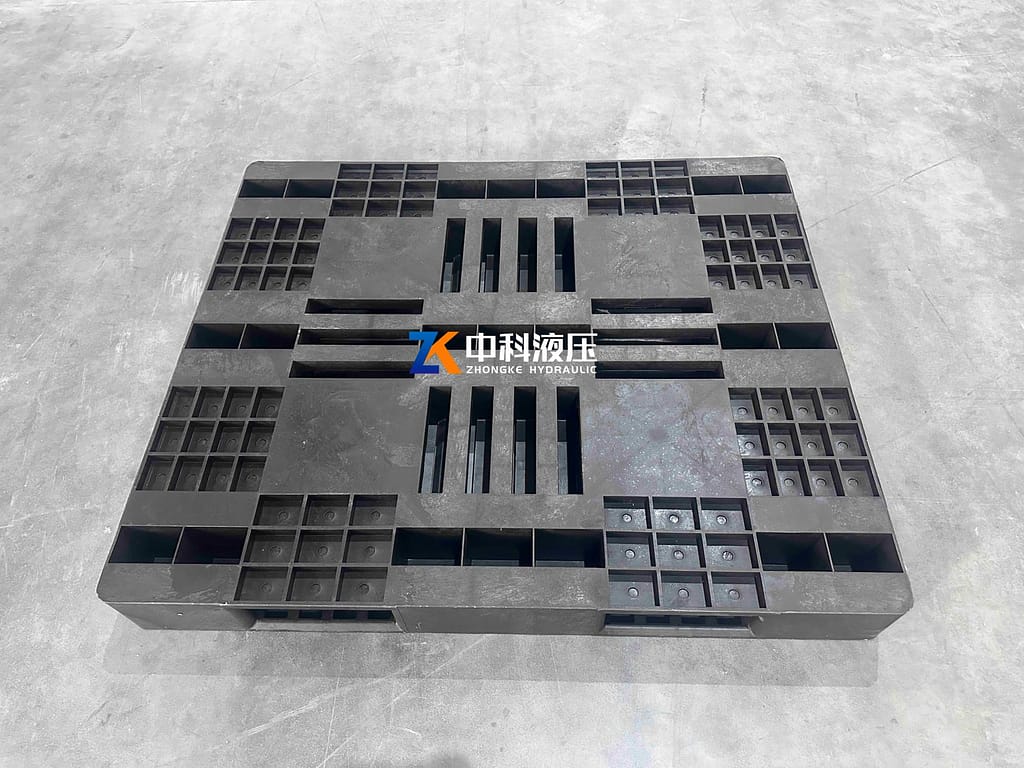
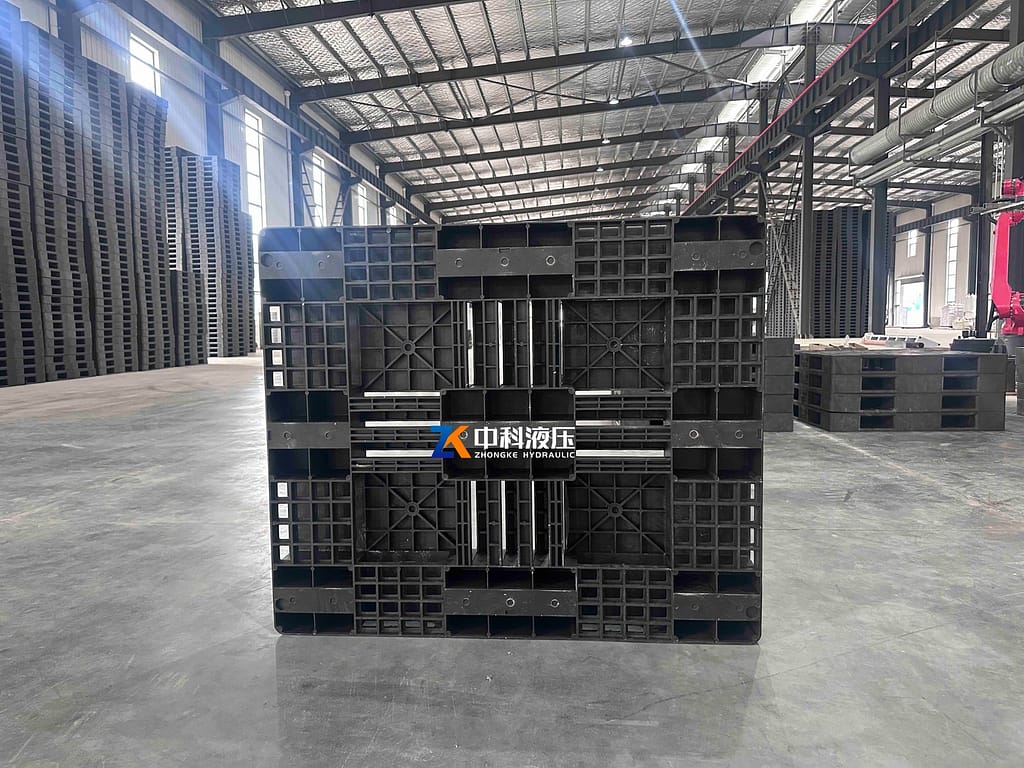
An automated storage and retrieval system (ASRS) is a warehouse where cranes, shuttles and conveyor lines move pallets without a human touching them. A pallet is ASRS-grade when it holds dimensional tolerance within about ±2 mm, deflects no more than roughly 10 mm under rated load on a high-bay shelf, carries at least 1,500 kg of dynamic load at shuttle speeds, and offers a flat, defined zone for an RFID tag. Fail any one of those four and the system will reject the pallet — not once, but every cycle, until someone pulls it out of circulation by hand.
That definition matters more in 2026 than it did two years ago, for one regulatory reason: the EU’s Packaging and Packaging Waste Regulation (PPWR) is now fully applicable, and it names transport packaging — pallets included — in its reuse targets, with 40% of covered transport packaging required to be reusable by 2030. Warehouses that want those reuse credits are automating at the same time, because reusable pallets only pay back when tracking is automatic. The plastic pallet market is forecast to grow from USD 12.84 billion in 2026 to USD 20.25 billion by 2034, with rackable formats — the ones automated systems actually want — growing fastest at 8.56% a year. Automation and recycled content are converging on the same pallet. Most molded pallets on the market today were not engineered for that meeting.
The 80% problem nobody puts in a brochure
Talk to Chinese warehouse integrators — the firms that commission stacker cranes and shuttle systems — and one number comes up again and again: roughly 80% of crane jams, pallet slips and unscheduled stops trace back to the pallet, not the equipment. The crane gets blamed. The procurement team that saved a few yuan per pallet by buying non-spec pallets does not get mentioned in the incident report.
The physics is unforgiving. The gap between a stacker crane’s fork and the shelf beam is typically 15–20 mm. A pallet that warps 5 mm over its length, or carries a molding flash along the bottom edge, fits fine on day one and jams on day forty, after thermal cycling and creep have done their work. Manual warehouses absorb this — a forklift driver nudges the pallet in. An automated line does not nudge. It stops, alarms, and waits for a technician, and the throughput model you sold to management dies a little more each shift.
This is also why the premium pooling players are designing for automation first. When Tosca and Cabka launched the CP1208 euro pallet in Madrid on 8 October — a 100% recycled plastic pallet with RFID integration and deck grooves that lock crates in place — Packaging Europe’s write-up framed it explicitly as an asset for automated fresh-produce lines, not a generic pallet. Injection-molded, pooling-service, closed-loop: that is one business. The volume end — factories that need tens of thousands of pallets a year made from their own waste stream — is served by compression molding, and it has to meet the same automation specs without the pooling contract attached.
Four numbers that decide whether your pallet gets in
If you are buying or producing molded recycled plastic pallets for an automated facility, the conversation should start with four numbers, not a price.
Tolerance: ±2 mm on length and width, diagonal difference under 2 mm. Manual warehouse specs tolerate ±5–10 mm. Automated systems do not, because the fork-to-beam clearance leaves no room for argument. For compression molding this is a mold and process question: a rigid steel mold holds footprint dimensions well, but warpage after demolding — driven by cooling asymmetry and feedstock variation — is what moves you out of spec. Consistent weight per pallet is the tell: if pallet-to-pallet weight varies more than about 3%, your dimensional consistency is probably wandering too.
Deflection: under 10 mm at rated load, measured on a shelf, not on the floor. A pallet spanning racking beams with no middle support bends. When deflection passes about 10–12 mm, photo-eye sensors on conveyor lines misread pallet position, and shelf beams see local stress rise sharply. Creep is the slower killer: recycled HDPE blends under sustained load deform for months, so a pallet that measures 6 mm on delivery can measure 12 mm by quarter three. Ask for a suspended-load deflection test over at least an hour, and a creep statement for anything living on 8-metre high bays.
Dynamic load: 1,500 kg minimum, with impact margin. Shuttles and cranes accelerate harder than any forklift driver. Chinese warehouse spec sheets converge on 1,500 kg dynamic and 4,000 kg static as the ASRS floor, with cold-chain and heavy-bay applications pushing toward 2,000 kg dynamic and 6,000–8,000 kg static. Our own recent trial is a useful reference point here: a pallet pressed on a ZK-P1800 large-platen press with a four-core-pulling mold, from 100% mixed recycled plastic, at 1,300 × 1,100 mm, came out at 23 kg with a 60-second hold and tested at roughly 2,000 kg dynamic and 6,000 kg static under ISO 8611 methods. Those are trial numbers on one material configuration — not a universal claim — but they show what the compression route delivers when the mold and the feedstock are engineered together rather than assumed.
RFID readiness: a recessed chip pocket, molded in. Retro-fitting tags onto a finished pallet costs a few RMB per pallet plus labor per cycle. Molding a chip pocket into the deck costs almost nothing extra and keeps the tag below the wear surface. Chinese smart-warehouse projects now commonly add 8–25 RMB per pallet for RFID integration; European projects budget in euros and add asset-tracking software on top. If your warehouse runs a WMS with pallet-level tracking, order the pocket. It is the cheapest automation feature you will ever spec.
Where compression molding honestly stands
Compression molding has one structural advantage in this fight: the pallet is one piece. No weld lines, no screws, no assembled feet that loosen after 10,000 shuttle cycles. The process fuses the whole melt under pressure, so the pallet’s weakest section is still a continuous polymer section — which is why properly made molded recycled pallets shrug off the impact loads that crack assembled or welded alternatives.
The honest weakness is dimensional discipline. Injection molding wins on out-of-the-mold precision because it forces material into a closed cavity at high pressure. Compression molding takes the shape from a heated mold but lets the material relax as it cools, and mixed recycled feedstock — the entire point of the process — adds batch-to-batch variability on top. So the tolerance battle is fought in three places: mold rigidity, cooling symmetry, and feedstock consistency. A supplier who quotes ASRS-grade tolerance without telling you how they control all three is selling you the yard test, not the warehouse test.
Moisture is the hidden fourth variable. Damp recycled flake stretches cycle time — a 60-second hold on dry material can drift toward double on wet feed — and inconsistent moisture shows up downstream as weight variation, which shows up as warpage, which shows up as a crane fault in November. This is why we keep insisting on pressing a customer’s actual material before quoting a line. The recycled plastic pallet machine is only as automation-ready as the material plan in front of it. Our dual-station press exists for the same reason: output per frame matters, but so does running two mold configurations so a 1,300 × 1,100 customer pallet and a 1,200 × 800 export pallet never fight over the same machine.
The cost math that closes the argument
The objection is always price: an ASRS-grade pallet costs more than a yard-grade pallet. Sometimes 10–20% more, depending on mold complexity and QC intensity. Here is the counter. A single stacker crane stop — technician walks over, clears the jam, restarts, logs the event — burns 20–40 minutes of system throughput. Do that twice a week across a fleet of marginal pallets and the downtime cost dwarfs the tolerance premium within a quarter. Chinese warehouse operators who retrofit after buying cheap pallets report remediation costs that exceed the original pallet fleet price, which is the most expensive way to learn this lesson.
Against that, compression molding keeps the input economics that make recycled pallets viable at all: mixed waste plastic in, one-piece pallet out, no pelletizing step, and for plants with their own waste stream, a feedstock cost near zero. You are not choosing between cheap pallets and automated-warehouse pallets. You are choosing whether the money you saved on feedstock gets kept as margin or paid back to the integrator in service calls.
What to demand before you sign
Three asks, all reasonable, all frequently skipped. First, a deflection and creep test report at your actual load and your actual lowest storage temperature — recycled blends behave differently at −20 °C, and a cold-chain ASRS amplifies every weakness. Second, pallet weight consistency data across a production run, not a single sample; ±3% is the working threshold. Third, a finished-pallet test against ISO 8611 methods with the numbers printed, because “suitable for automated warehousing” is a marketing phrase, not a test result. A supplier who pushes back on any of these three is telling you something useful before the crane does.
Automation is not coming for the recycled plastic pallet business — it is already here, and the PPWR timeline means standardization pressure only increases from here. Molded recycled pallets belong in automated warehouses. They belong there on purpose, engineered to tolerance, not smuggled in through the same spec sheet that serves the yard.


