
Automated warehouses place different demands on pallets than conventional manual handling operations. A pallet must not only support its load but also interface reliably with conveyor rollers, automated guided vehicles (AGVs), robotic handling equipment, and storage systems.
For presswood pallet manufacturers and buyers, this creates an important engineering challenge: how can a pallet be specified so that its dimensions, stiffness, surface geometry, and structural performance remain compatible with the intended automation system?
The answer is not to adopt one universal dimensional tolerance. It is to define the pallet requirements around the actual handling equipment, load configuration, operating environment, and acceptance criteria.
This guide explains the main factors to evaluate before selecting a presswood pallet for an automated warehouse.
1. Why Pallet Consistency Matters in Automation
Manual handling can sometimes accommodate small variations in pallet geometry. An operator can reposition a pallet, correct its orientation, or notice a damaged component before loading.
Automated systems have less flexibility unless they are specifically designed to accommodate variation.
A conveyor may rely on predictable contact points. An AGV may require a defined fork-entry opening. A robotic system may use sensors to locate the pallet or its load. An automated storage and retrieval system may impose specific limits on dimensions, deflection, and support conditions.
If a pallet falls outside the equipment’s permitted range, the result may be a failed transfer, a sensor alarm, a damaged load, or an unplanned manual intervention.
However, not every automated warehouse requires the same pallet specification. A floor-level AGV transfer, a roller conveyor, and a high-bay rack may impose different mechanical requirements.
The first step is therefore to identify the actual handling system rather than assume that a pallet suitable for one application will automatically work in another.
2. Define the Interface Requirements Before Ordering Pallets
A useful pallet specification begins with a clear description of the intended application.
Document the following information before requesting samples or quotations:
- Nominal pallet length, width, and height
- Maximum and minimum permitted dimensions
- Total pallet weight and expected variation
- Fork-entry geometry and clearance
- Deck flatness and permitted deflection
- Load distribution and overhang
- Conveyor contact points and support spacing
- AGV fork dimensions and lifting method
- Storage rack or shuttle support conditions
- Sensor, stop, and positioning interfaces
- Environmental conditions, including moisture and temperature
The equipment manufacturer or system integrator should confirm which dimensions are critical.
For example, an AGV may require sufficient clearance for its forks to enter without contacting the pallet feet. A roller conveyor may require a suitable underside geometry to avoid unstable support. A high-bay storage system may impose a deflection limit that is not relevant to a pallet used only for floor transport.
The final specification should reflect the actual system interface, not a generic description such as “suitable for automation.”
3. Dimensional Tolerance Is a System Requirement
Pallet dimensions should be expressed as nominal values with explicit upper and lower limits.
For example, a specification might define a nominal length and a permitted deviation around that value. The acceptable deviation must be established by the handling system designer and verified through production measurement.
A statement such as “high precision” is insufficient because it does not identify which dimensions are controlled or how they are measured.
A practical dimensional inspection plan should cover:
- Overall length and width
- Total height
- Foot height and position
- Fork-entry width and height
- Deck thickness and flatness
- Diagonal measurements where squareness matters
- Critical corner and edge geometry
Measurements should use a documented method and suitable equipment. The sampling plan should reflect production volume, process capability, and the risk associated with a nonconforming pallet.
A tolerance achieved by one sample does not prove that every pallet from a production batch will remain within that range.
Manufacturers should therefore evaluate both individual conformity and batch-to-batch consistency.
4. Flatness and Deflection Are Different Properties
Flatness describes the geometry of an unloaded surface. Deflection describes how the pallet changes shape under a specified load and support condition.
Both may matter in automated handling, but they are not interchangeable.
A pallet may have a flat deck when empty yet deflect excessively when carrying a concentrated load. Conversely, a pallet with a small initial surface variation may still perform acceptably in a system designed to accommodate it.
The required limits depend on the application.
A pallet carrying evenly distributed cartons on a floor conveyor may face different conditions from one supporting heavy drums or an unevenly distributed industrial load on a rack.
The engineering review should establish:
- The load and its distribution.
- The support points and spacing.
- The maximum permitted deformation.
- Whether the measurement is taken before, during, or after loading.
- The environmental conditions under which the pallet operates.
- The inspection method and acceptance criteria.
Where applicable, the ISO 8611 series provides recognized methods for evaluating flat pallets. The relevant tests and performance criteria should be selected for the intended use rather than relying on a single static load figure.
5. Check Fork Entry, Conveyor Contact, and Underside Geometry
The underside of a pallet is especially important in automated handling.
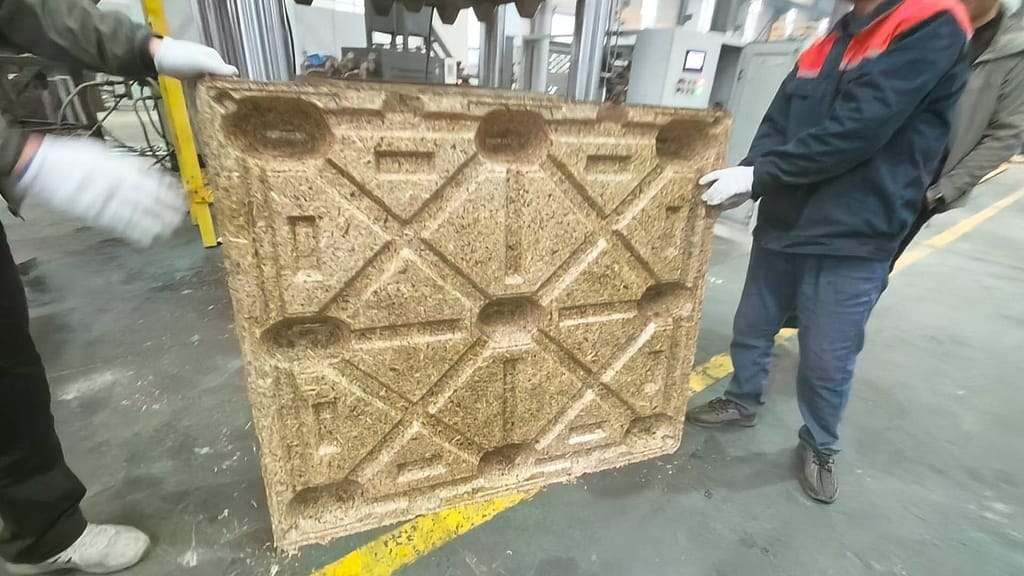
A pallet may be designed with nine feet, runners, a perimeter base, or another support configuration. These structures affect fork access, conveyor contact, load transfer, and stability.
Before finalizing a design, compare the pallet geometry with the equipment drawings.
For AGV applications, verify the fork spacing, fork thickness, approach angle, lifting height, and available clearance. Check whether the pallet can be approached from the required directions.
For roller conveyors, determine which surfaces carry the load and whether the pallet has sufficient support across the conveyor’s contact points.
For chain conveyors or transfer stations, examine the interface between the pallet’s feet or runners and the conveying mechanism.
For automated storage systems, confirm the support conditions and permitted deflection under the actual load.
These checks are particularly important when a pallet design is being transferred from a manual warehouse to an automated facility. A design that performs adequately in manual forklift handling may need additional validation before being used in a more constrained system.
6. Load Capacity Must Match the Actual Application
Pallet load ratings should not be treated as interchangeable numbers.
Static load, dynamic load, and racking load describe different conditions. The support arrangement, load distribution, pallet design, and test procedure influence the results.
A pallet that supports a large evenly distributed load on the floor may not be suitable for the same load when supported only at selected rack points.
For automated warehouses, the specification should identify the actual load case, including:
- Product weight and dimensions
- Load distribution and center of gravity
- Whether goods are stacked in multiple layers
- Forklift, AGV, conveyor, and rack support conditions
- Expected impact or acceleration during movement
- Required service life and handling frequency
Testing should use the intended pallet configuration and representative loads.
ISO 8611-1:2025 describes test methods for new flat pallets, while the applicable performance and working-load requirements should be determined using the relevant parts of the ISO 8611 series.
For high-risk applications, field validation with the intended equipment and load configuration may also be necessary.
A load rating should be supported by documented testing, not inferred from pallet weight, material density, or press tonnage alone.
7. Moisture and Temperature Can Affect Dimensional Stability
Presswood pallets are manufactured from wood particles or fibers combined with a suitable binder and consolidated in a mold.
The final dimensions and mechanical behavior depend on the material formulation, moisture conditions, pressing process, mold design, and post-production conditioning.
Moisture exposure during storage and use may affect some material systems. Temperature can also influence the behavior of the pallet and the goods it carries.
For automated warehouses, dimensional stability should be evaluated under the conditions the pallet will actually encounter.
Where necessary, test pallets after conditioning under representative temperature and humidity conditions. Record dimensional changes and any resulting effects on fork clearance, deck geometry, or conveyor interaction.
Manufacturers should avoid assuming that results from a dry factory environment will automatically apply to cold storage, humid warehouses, or outdoor handling.
8. How Presswood Pallet Manufacturers Can Improve Process Control
A consistent automated-handling pallet begins with a controlled manufacturing process.
For presswood pallet production, important process variables may include:
- Raw-material particle size and moisture
- Adhesive dosage and mixing uniformity
- Material distribution in the mold
- Mold temperature and pressure
- Holding time and total cycle time
- Demolding conditions
- Post-production conditioning
- Finished-product inspection
The specific limits depend on the material formulation and product design.
A manufacturer should define critical dimensions, measure them consistently, and investigate recurring variation rather than relying solely on final visual inspection.
Where the production volume justifies it, statistical process control can help identify gradual changes in dimensions, weight, or other measurable characteristics.
Inspection records should be linked to the relevant production batch so that recurring problems can be traced to raw-material variation, mold condition, or process settings.
9. A Practical Acceptance Checklist for Automated Warehouses
Before approving a presswood pallet for automated handling, the buyer and supplier should agree on the following:
- A complete dimensional drawing with tolerances.
- The required pallet weight range.
- Fork-entry and underside-interface requirements.
- Deck flatness and load-dependent deflection limits.
- Static, dynamic, and racking test requirements where applicable.
- The intended load distribution and handling conditions.
- Environmental conditioning requirements.
- Sampling frequency and measurement procedures.
- Acceptance criteria for defects and dimensional variation.
- A trial using the actual AGV, conveyor, or storage system.
- Procedures for reporting, tracing, and correcting nonconforming pallets.
- Revalidation requirements following changes to the pallet design or manufacturing process.
This checklist helps both parties establish a measurable specification before full-scale production.
How ZK Hydraulic Can Support Presswood Pallet Projects
ZK Hydraulic provides hydraulic presses and molds for presswood pallet manufacturing. When developing a pallet for automated handling, the equipment configuration and mold design should be evaluated alongside the finished-product requirements.
The Presswood Pallet Machine range provides a starting point for reviewing production equipment.
For additional manufacturing context, see the PalletsBiz guide to presswood pallet production.
The objective is to establish a repeatable production process that can deliver pallets meeting the agreed specification. Final suitability for an automated warehouse must still be confirmed through product testing and system-level validation.
Conclusion
A presswood pallet intended for an automated warehouse should be specified as part of a complete handling system.
Dimensional tolerance, flatness, deflection, fork entry, underside geometry, load capacity, and environmental stability all contribute to reliable operation. Their relative importance depends on the actual equipment and application.
The most effective approach is to define the interface requirements first, agree on measurable acceptance criteria, and validate representative pallets under realistic conditions.
For manufacturers and buyers, this process reduces uncertainty and creates a clearer basis for comparing pallet designs, controlling production quality, and integrating pallets into automated logistics systems.


