
Turning Reed Waste into Molded Pallets
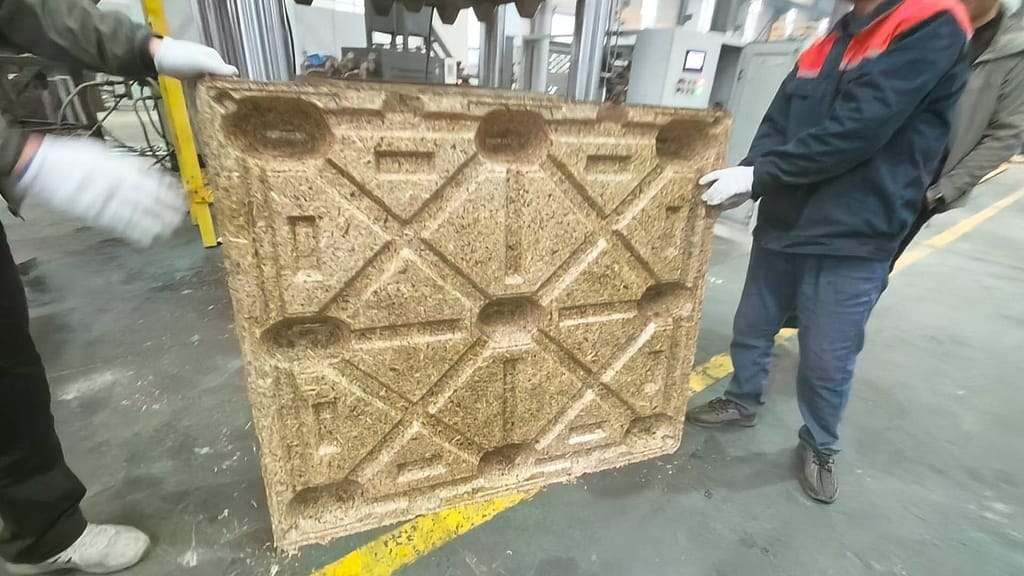
Agricultural residues can offer new opportunities for molded pallet production when they are properly processed and matched with a suitable molding system. ZK Hydraulic recently conducted a molding trial using reed material supplied by a customer to evaluate its suitability for producing molded pallets.
The trial was carried out using a ZK-1600 hydraulic press and a nine-foot pallet mold manufactured by ZK Hydraulic. The results demonstrated that the prepared reed material could be formed into pallets under the tested conditions, expanding the range of potential raw materials for molded pallet manufacturing.
For businesses with access to locally available agricultural residues, this approach may provide another option for converting low-value biomass into practical transport and packaging products. However, each material must be evaluated individually before a commercial production process is established.
1. Raw Materials and Preparation
The customer-supplied reeds were crushed into particles approximately 5–15 mm in size before molding.
The measured moisture content was approximately 15%. No additional drying step was used in this specific trial. This should not be interpreted as a general recommendation for all reed materials, because moisture content, storage conditions, particle characteristics, and the selected adhesive system can affect the required preparation process.
The trial mixture consisted of:
- Crushed reed material: 57.6 kg
- MDI adhesive: 2.4 kg
- Adhesive supplier: Wanhua
- Mixing time: 40 seconds
- Total mixture: 60 kg
The MDI adhesive accounted for 4% of the total mixture by weight.
The mixture was prepared for the molding test, with approximately 20 kg allocated to each pallet. In commercial production, the appropriate material quantity and adhesive ratio should be established through repeatable trials and quality checks.
2. Molding Process and Machine Parameters
The trial used a ZK-1600 hydraulic press equipped with a nine-foot pallet mold manufactured by ZK Hydraulic. The mold was designed for a pallet measuring 1,200 × 1,000 mm.
The main recorded parameters were:
| Parameter | Trial setting |
|---|---|
| Hydraulic press | ZK-1600 |
| Mold configuration | Nine-foot pallet mold |
| Mold size | 1,200 × 1,000 mm |
| Mold temperature | 170°C |
| Pressing pressure | 23 MPa |
| Pressure-holding time | 120 seconds |
| Mixture per pallet | Approximately 20 kg |
| Recorded total operating cycle | 226 seconds |
The recorded operating sequence included material distribution, fast mold closing, slow mold closing, pressure holding, mold return, and release-agent spraying.
The 226-second figure represents the total operating cycle recorded during this particular trial. It is not a guaranteed commercial production cycle. Actual output depends on factors such as material preparation, feeding method, mold design, automation level, operator workflow, and the time required to maintain consistent product quality.
For a production project, the machine configuration and process parameters should be confirmed through material trials and a detailed assessment of the customer’s required output.
3. Test Results: Appearance, Dimensions, and Weight
Three pallets were produced during the trial.
Under the tested conditions, the pallets showed a smooth surface, clean edges, and no observed sticking to the mold. The results provided an encouraging initial indication that the prepared reed mixture could be molded into a usable pallet shape.
The recorded product information was as follows:
| Item | Recorded result |
|---|---|
| Pallet length | 1,200 mm |
| Pallet width | 1,000 mm |
| Pallet height | 135 mm |
| Measured pallet weight | 19.7 kg |
| Number of pallets produced | 3 |
Preliminary drop and bending tests indicated promising toughness and load behavior under the test conditions. These observations are useful for further development, but they do not establish a certified load rating, long-term durability, or suitability for every handling and storage application.
The final pallet performance must be verified against the customer’s requirements, including static load, dynamic load, racking conditions where applicable, impact resistance, repeated handling, and environmental exposure.
The initial mixture allocation was approximately 20 kg per pallet, while the recorded finished pallet weight was 19.7 kg. This difference should be considered when refining the material balance and confirming the final production specification.
4. Expanding the Range of Biomass for Molded Pallets
Reed is one of many agricultural and plant-based materials that may be evaluated for molded pallet production. ZK Hydraulic has also worked with samples and trial materials from different regions, including:
- Hemp stalks supplied from the United States
- Flax stalks from France
- Coconut fiber from Thailand
- Rice husks from Vietnam
- Oil palm residues from Malaysia
- Date palm residues from the Middle East
- Chili stalks and cotton stalks from China
These materials differ in fiber structure, bulk density, moisture content, particle shape, and bonding characteristics. As a result, there is no single molding formula that can be applied to every type of biomass.
A successful production process depends on several factors:
Raw material preparation: Particle size and consistency influence material distribution and the final pallet structure.
Moisture control: Excessive or insufficient moisture can affect bonding, heat transfer, molding stability, and finished-product quality.
Adhesive selection: The adhesive system and dosage must be suitable for the raw material and intended application.
Mold design and temperature: Mold geometry, heating conditions, pressure, and holding time need to be adjusted to the material and pallet design.
Product validation: Finished pallets should be evaluated against the customer’s dimensional, weight, strength, and handling requirements.
For companies located near agricultural processing facilities, using suitable local residues may help create additional value from materials that would otherwise have limited applications. The actual economic and environmental benefits, however, depend on local material availability, transport, adhesive consumption, energy use, product performance, and end-of-life arrangements.
5. Choosing the Right Pallet Molding Technology
Different raw materials require different processing approaches. Selecting the right equipment begins with understanding the feedstock and the intended pallet specifications.
A Presswood pallet molding machine is designed for suitable wood particles, such as sawdust and wood shavings, as well as compatible plant-based residues used with an appropriate adhesive system. Depending on the raw material, the production line may require crushing, drying, mixing, feeding, hot pressing, and finishing.
A Plastic Pallet molding machine follows a different processing route. Its configuration depends on the type and condition of the plastic feedstock, such as suitable recycled PP or PE materials, and on the target pallet design and production requirements.
The two technologies should not be treated as interchangeable. Raw material characteristics, processing conditions, pallet specifications, and production objectives determine which solution is appropriate.
For more information, explore these related resources:
- The Production Process of Presswood Pallets
- Best Raw Materials for Pressed Pallets Production
- Glue for Presswood Production
- Presswood Pallet vs. Plastic Pallet: Which Is Better for Your Operations?
6. Discuss Your Raw Materials with ZK Hydraulic
A new raw material should be evaluated through a practical trial rather than selected on the basis of appearance or composition alone.
If your company has access to reed waste or other agricultural residues, ZK Hydraulic can assess the material and discuss a suitable testing approach based on the information available.
When inquiring, it is helpful to provide:
- The type and source of raw material
- Typical moisture content
- Particle size and any existing pretreatment
- Target pallet dimensions and approximate weight
- Required static and dynamic load performance
- Expected production capacity
- Available energy sources and site conditions
These details help establish whether additional material preparation is needed and which machine and mold configuration should be evaluated.
ZK Hydraulic develops hydraulic presses and molds for molded pallet production. By combining equipment design with material testing, the goal is to identify a practical process that meets each customer’s raw material conditions and product requirements.
Contact ZK Hydraulic to discuss your raw materials and molded pallet production project.


