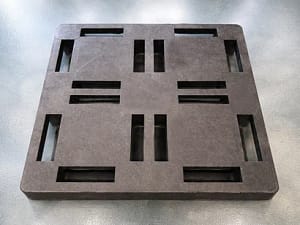
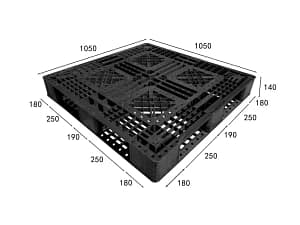
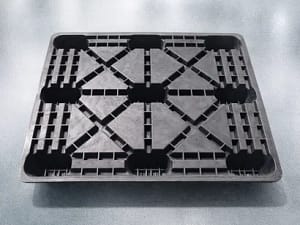
A freezer does not fail a pallet because the pallet is made of recycled plastic. It fails the pallet because of what else rides along in the regrind.
That distinction is worth real money. Cold-chain buyers in Europe and North America keep writing recycled content out of the spec after one bad winter. They blame the feedstock. Most of the time the culprit is a polypropylene fraction nobody measured, or a corner radius nobody drew.
The definition, before anything else. A freezer-rated pallet is not a pallet with a lower load number. It is a pallet whose polymer stays ductile below the glass transition of its weakest component, and whose geometry has no notch sharp enough to start a crack when a fork tine lands on it at −25°C. Load capacity is almost never the binding constraint in a cold store. Impact tolerance is.

Recycled Content Is the Wrong Number to Argue About
Polypropylene’s glass transition sits between −20°C and 0°C, depending on grade. Homopolymer is the worst case. Below roughly −5°C it stops deforming and starts shattering. Random copolymer buys you to about −20°C, impact copolymer to −30°C. HDPE is a different animal entirely, with a glass transition near −120°C. A freezer is nowhere close to its limit.
That gap shows up hard in testing. Drop a 20 kg load 1.2 metres onto concrete at −25°C and HDPE containers survive fifty-plus drops. PP copolymer containers fail somewhere between five and fifteen. Run repeated freeze-thaw cycles between −25°C and +25°C and PP micro-cracks after 200 to 500. HDPE holds past a thousand.
Now picture what “mixed post-consumer regrind” actually contains. Bottles, crates, caps, film, a few woven bags. A meaningful PP share is normal. Twenty-five to thirty percent is not unusual. At that level the pallet’s corner behaves like PP at −25°C, not like HDPE, whatever the recycled-content certificate says.
This is why feedstock questions belong before tonnage questions. Mixed rigid bales are cheap for exactly the reason they are risky in a freezer. Cheap material plus a cold store is how a five-year pallet becomes eighteen months of pallet.
Where the Cracks Actually Start
Not in the middle of the deck. Field reports from cold-chain operators keep pointing at the same four places: the root of the corner feet, the transition where stringers meet cross-bearers, the edge of the fork entry, and the base of a rib.
Every one of those is a stress concentration. Compression moulding makes it worse if the tool has a sharp internal corner, because material packs unevenly there and leaves a density gradient behind. A crack does not need a manufacturing defect. It needs a notch and one impact.
The timing catches people out. Operators in northern China report first failures appearing around −3°C, in late autumn. Not at the bottom of winter. The pallet has already spent its impact reserve by then, and nobody has changed handling habits yet.
There is a well-documented version of this in the Netherlands. An operator ran 800 rackable pallets through a sub-zero freezer and kept welding deck cracks. The welds failed again at −20°C, because the repair sat in the same brittle regime as the original damage. Rack damage fell to zero only after the fleet was replaced with cold-designed pallets and the weld-and-hope policy was dropped.
Six Lines Worth Putting in the Purchase Order
Most pallet POs specify dimensions, colour and a load rating measured at 23°C. In a freezer, that document answers the wrong question. Here is what I would want answered in writing instead.
| Line | Ask for | Why |
| PP fraction | ≤15% by weight, per batch, method named (DSC or FTIR) | Controls the ductile-brittle transition |
| Notched impact at −25°C | Charpy or Izod value with the test temperature printed on the report | A room-temperature number is marketing |
| Moisture before moulding | ≤0.5% | Steam flashes in the cavity and leaves voids |
| Corner and rib radius | ≥8 mm internal, no sharp transitions | Removes the notch that starts the crack |
| Section density | ≥900 kg/m³, measured on a cut section, not a whole part | Voids hide inside the wall |
| Load re-test cold | Dynamic and static, after 24 h at −25°C | Confirms the rating survives the duty |
None of these are exotic. All six are cheap to check and expensive to skip.
Be honest about one gap in the paperwork. No standard currently issues a “freezer rating” for pallets. ISO 8611 conditions are 23°C, and suppliers who quote a single dynamic load figure are quoting a room-temperature result. That is not dishonesty. It is just an incomplete answer, and the buyer has to close it with a clause.
Your Load Rating Is Probably Fine
Here is the counterintuitive part. Cold makes a pallet stiffer, not weaker. Flexural modulus climbs to roughly 2,500 MPa for PP at −20°C and about 1,800 MPa for HDPE. Creep under constant load drops. A pallet rated 1,000 kg dynamic at room temperature generally still carries that load in a −25°C freezer.
So the pallet that collapses under a stack is rarely the story. The pallet that shatters when a fork tine clips a corner is. One is a load problem. The other is a material and geometry problem, and warehouses keep buying tonnage to solve it.
That misread is expensive twice. First you pay for a heavier pallet than the duty needs, then you pay again in replacements because the extra weight did nothing for impact.
Food Contact Comes Before the Resin
One question decides more of the spec than any polymer datasheet. Does the pallet touch food, or only the carton?
Indirect contact — cases, layer pads, shrink-wrapped trays — is the normal case in a cold store, and recycled material is broadly accepted there subject to your own QA sign-off. Direct contact is a different regime. In the US it runs through FDA’s no-objection letter process, which is use-specific: a resin cleared for cold storage is not cleared for hot fill. In the EU, EFSA authorises the recycling process itself and expects decontamination efficiency to be demonstrated by challenge tests. FAO made the same point from a public-health angle in a 2026 analysis: recycled plastics reduce waste, and food-contact uses need stronger safeguards.
Get that classification wrong and you rebuild the fleet. Get it right and recycled content stops being a debate.
The Money, Roughly
The wood alternative is not getting cheaper to run. A new EUR-1 pallet in the DACH region is around €12.19 in October 2026, with the HPE pallet timber index flat at 110.15 points. German producer unit values for flat wood pallets sat at €10.64 per piece in 2025. Meanwhile TTF gas rose 15% between 9 and 23 October to roughly €94/MWh, the input that drives kiln drying and heat treatment. EUDR obligations also start applying to large and medium companies on 30 December.
So the solid-wood route holds price while its processing costs climb. That is the backdrop on the demand side. Straits Research puts the global cold storage market at USD 204.26 billion for 2026. China alone reached 270 million cubic metres of capacity in June, up 4.6% year on year. Fewer than a quarter of those facilities qualify as high-standard, and every one that upgrades needs hygienic, moisture-proof load carriers.
Run the replacement math on a mid-size freezer store. Eight hundred pallets in rotation, 2.3% monthly breakage, and you are scrapping about eighteen units a month. At roughly $22 each that is $400 a month, or close to $5,000 a year, before you count product loss, cleanup labour or a collapsed stack. Push breakage to 0.1% and the same fleet loses under one pallet a month. The saving is not the pallet price. It is the difference between buying pallets and buying replacements.
Our recycled plastic pallet machine line exists to hit that density and that tolerance from unwashed, unpelletised waste. Worth saying plainly: the machine does not fix a bad feedstock. It only makes a good one repeatable.
Why the Press Still Matters
Cold-store performance is decided at the press as much as in the resin. Voids are the enemy, and voids come from short shots, damp material and uneven packing.
Compression moulding at 1,600 to 3,000 tonnes gives you a dense section and a slow, controlled cavity fill. On our four-way core-pulling tooling, a 23 kg pallet runs a 60-second cycle and tests at 2,000 kg dynamic and 6,000 kg static. The P20 moulds we machine in-house are rated to 300,000 cycles, so the second and third pallet of a set come off the same tool with the same wall thickness. Dual-station platforms cut the non-productive time out of that cycle, which is why we bothered to build one.
One design decision is worth making now rather than later. If the fleet will ever carry RFID, put the pocket in the mould. Regulators are moving toward lot-level traceability, not away from it. FDA is holding a public meeting on 6 November 2026 about lot-code flexibility and mixed-lot pallets, and the Food Traceability Rule’s compliance date has been pushed to 20 July 2028. The date moved. The direction did not. RFID on returnable transport equipment is already the most mature deployment in food logistics. A 40 × 20 mm pocket costs almost nothing at tool design and a second mould later.
The Bottom Line
Freezer pallets fail for boring, fixable reasons. A PP fraction nobody measured. A sharp corner nobody drew. Damp regrind nobody dried. None of that is a reason to abandon recycled material in cold chain. It is a reason to write six lines into the PO and test at the temperature the pallet will actually live at.
The operators who get this right stop treating the freezer as a storage condition and start treating it as a material specification. Their pallets cost more per unit and less per year, which is the only comparison that survives an audit.
Specifying a cold-store fleet, or building a line to supply one? Send our engineers the temperature range and the duty cycle — or browse the project notes to see how other producers have handled mixed feedstock.