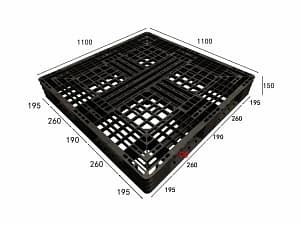
Agricultural waste for presswood pallets can create new opportunities for manufacturers looking to reduce dependence on conventional wood chips and develop alternative sources of raw material. Rice husks, straw, reeds, coconut residues, and other plant-based materials may be worth investigating, but their suitability cannot be determined by appearance or local availability alone.
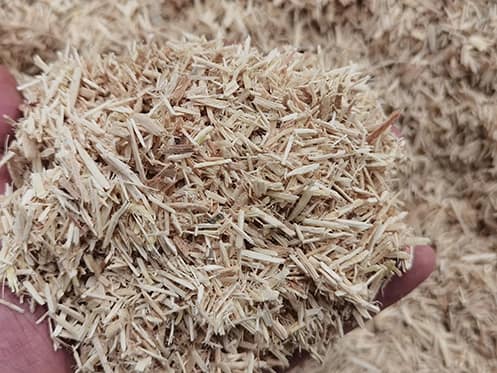
A successful molded pallet production process requires more than a material that can be compressed. The feedstock must be prepared consistently, mixed with a suitable binder, processed under controlled conditions, and evaluated against the required pallet specifications.
This guide explains how to assess agricultural residues, design a practical trial, record meaningful results, and decide whether a new feedstock deserves further investment.
1. Why Test Agricultural Waste for Presswood Pallets?
Conventional wood chips and shavings are widely used in molded wood pallet manufacturing. However, their availability, delivered price, particle characteristics, and moisture content can vary by region and supplier.
Agricultural residues may provide an alternative feedstock where local industries generate sufficient quantities of suitable plant material.
Potential materials include:
- Rice husks and rice straw
- Wheat straw and other cereal residues
- Reeds and similar fibrous plants
- Coconut fiber and processing residues
- Flax stalks and other crop stems
- Selected palm residues and agricultural processing waste
These materials should be treated as candidates for testing, not as interchangeable ingredients.
Two residues that look similar may behave differently during grinding, drying, mixing, heating, and compression. Even different batches of the same material may require adjustments.
The commercial objective is therefore not simply to prove that a pallet can be produced once. It is to establish whether the material can be processed repeatedly into acceptable pallets at a commercially viable cost.
2. Evaluate the Feedstock Before Running the Press
A structured assessment begins before material enters the production line.
Particle size and distribution
Measure the prepared material rather than relying only on the grinder’s nominal screen size.
Record the particle-size range, the proportion of fine particles, the presence of oversized pieces, and any visible contamination.
Particle size can influence material flow, bulk density, binder distribution, mold filling, and the uniformity of the finished pallet. The best preparation conditions depend on the feedstock and the pallet design.
A material that grinds easily is not necessarily the material that produces the most consistent molded product.
Moisture content
Measure the incoming moisture content and record how the sample was collected and tested.
Moisture influences drying requirements, heat transfer, and the behavior of the material during compression. Its effect also depends on the binder system, particle structure, and mold conditions.
Do not apply one universal moisture target to every agricultural residue. Instead, establish a controlled test range appropriate to the material and process.
For each trial, record both the incoming moisture condition and any relevant changes during preparation.
Bulk density and handling behavior
Some agricultural residues are bulky and difficult to feed consistently. Others may contain a mixture of fibers, fines, and relatively dense particles.
Record the mass of material in a defined container volume, together with observations about bridging, settling, dust generation, and feeding consistency.
Bulk density is especially useful when comparing the volume of material that must be stored, transported, metered, and charged into the mold.
Contamination and material variability
Inspect each batch for soil, stones, metal fragments, excessive dust, and other unwanted material.
For residues such as rice husks, it may also be useful to characterize ash content and mineral composition when these properties could affect equipment wear, binder demand, or product quality.
These measurements should be used to identify potential risks for the specific process, rather than to assume that a particular residue will always cause a certain result.
3. Establish a Controlled Trial Procedure
A reliable material trial changes a limited number of variables at a time.
If particle size, moisture, binder dosage, mold temperature, and pressing time are all changed simultaneously, it becomes difficult to determine which change produced the observed result.
A practical trial can follow these stages.
Stage 1 — Sample preparation
Identify the material source, batch, particle-size distribution, moisture condition, and contamination risks.
Stage 2 — Establish a baseline recipe
Record the binder type, dosage basis, mixing method, material charge, mold temperature, pressure program, and holding time.
Stage 3 — Run controlled molding trials
Observe filling, compression, release, surface quality, visible defects, and cycle consistency.
Stage 4 — Inspect and test the pallets
Measure finished dimensions, mass, visible defects, and relevant mechanical performance.
Stage 5 — Repeat and compare
Repeat the trial with representative batches before deciding whether the feedstock is suitable for production.
4. Select a Suitable Binder and Mixing Process
The binder must be evaluated together with the feedstock.
Different plant materials have different surface characteristics, absorption behavior, moisture conditions, and particle structures. A formulation that works with conventional wood chips should not automatically be assumed to work with straw, reeds, or rice husks.
The trial record should include:
- Binder type and supplier specification
- Binder dosage and whether it is expressed as a percentage of dry or as-received material
- Material moisture before mixing
- Mixing time and observed distribution
- Material temperature where relevant
- Any visible agglomeration or uneven coating
For example, a reported binder dosage of 5% is ambiguous unless the calculation basis is defined. Five kilograms of binder per 100 kilograms of dry feedstock is not the same formulation as five kilograms per 100 kilograms of wet feedstock.
The same principle applies when comparing recipes from different trials.
For background, see the PalletsBiz guide to UF, MUF, and MDI adhesives.
When MDI is used, chemical handling and workplace controls must follow the supplier’s safety data sheet and applicable occupational requirements. The U.S. OSHA information on MDI is a useful reference for identifying the substance and understanding its workplace hazards.
5. Optimize the Molding Process Without Hiding Quality Problems
A successful trial must produce a pallet that meets its intended requirements, not merely a pallet that releases from the mold.
Record the key process conditions, including mold temperature, the programmed pressing sequence, holding time, and material charge.
Observe whether the material fills the mold consistently and whether the pallet releases cleanly. Record defects such as cracking, incomplete formation, uneven surfaces, dimensional variation, or visible damage during removal.
If a problem occurs, change one variable at a time where practical and document the result.
A shorter cycle is not automatically better if it increases rejection rates. Similarly, a visually attractive surface does not prove that the pallet has adequate strength or durability.
For equipment and tooling considerations, review the ZK Hydraulic presswood pallet machine range and its custom pallet mold capabilities.
The correct process settings should be established through controlled trials on the intended material, pallet design, and production equipment.
6. Evaluate the Finished Pallet Against Its Intended Application
Visual inspection is only the first stage of quality evaluation.
The inspection plan should include the dimensions, mass, geometry, fork-entry features, surface condition, and other requirements specified for the pallet.
Mechanical testing must be appropriate to the intended application and load conditions.
For flat pallets, ISO 8611-1:2025 specifies test methods covering nominal-load testing, maximum-working-load testing, and durability comparison testing. The standard also notes that specific load-capacity tests do not replace field testing of particular pallet designs.
The required test plan depends on how the pallet will be used. A nestable export pallet, a pallet for repeated warehouse handling, and a pallet intended for a demanding industrial load may require different evaluation criteria.
Do not infer a safe working load from appearance, finished mass, or a successful single molding cycle.
Export and phytosanitary considerations
If the pallet will be used in international trade, assess the applicable packaging requirements separately from its mechanical performance.
The IPPC’s ISPM 15 standard covers phytosanitary measures for regulated wood packaging material and identifies exemptions for certain processed wood materials.
However, a pallet made from agricultural residues should not automatically be classified as exempt without checking its actual composition, construction, destination requirements, and the relevant plant-protection authority’s interpretation.
A material trial proves neither regulatory compliance nor universal suitability for export.
7. Compare Feedstocks on Commercial Performance
The cheapest raw material at the source may not be the cheapest material per acceptable pallet.
A useful evaluation should include the delivered cost, preparation requirements, binder consumption, energy use, labor, maintenance, production yield, and disposal or reprocessing of rejected material.
One useful comparison is:

For a more complete production-cost model, add drying, grinding, electricity, labor, maintenance, and other relevant operating expenses.
These costs should be measured or clearly identified as estimates.
A residue that requires intensive drying or grinding may lose its apparent price advantage. Conversely, a locally available material may be commercially attractive if it can be processed consistently with manageable preparation costs.
The correct comparison is therefore not simply cost per tonne of raw material. It is the total cost and reliability of producing acceptable pallets.
For more background on feedstock selection, see the PalletsBiz raw material guide.
8. Use a Standardized Material Trial Record
Every trial should produce a record that can be compared with later experiments.
| Record category | Information to capture |
|---|---|
| Feedstock identity | Material type, supplier, source, batch |
| Preparation | Particle-size distribution, moisture, contamination |
| Formulation | Binder type, dosage, calculation basis |
| Process | Mold temperature, pressure program, holding time |
| Production | Charge mass, cycle time, release behavior |
| Finished pallet | Dimensions, mass, appearance, defects |
| Performance | Applicable mechanical test results |
| Economics | Preparation cost, binder consumption, accepted yield |
| Limitations | Untested conditions, unresolved defects, further work |
A standardized record makes it easier to distinguish an isolated successful trial from a repeatable production process.
It also allows sales teams to discuss material feasibility with customers using documented evidence rather than assumptions.
9. When Is a New Agricultural Residue Ready for Commercial Production?
A material should move from preliminary testing to commercial evaluation only when the main technical and economic questions have been answered.
The following checklist can help structure that decision.
Commercial readiness checklist:
Material source and batch characteristics are documented.Particle size and moisture can be controlled consistently.
Binder selection and dosage basis are recorded.
The pallet releases from the mold reliably.Finished dimensions and mass meet the agreed specification.
Relevant mechanical tests meet the intended application requirements.
Repeat trials show acceptable consistency.Feedstock preparation and production costs have been evaluated.
Supply availability and batch-to-batch variability have been assessed.
Applicable export and workplace safety requirements have been reviewed.
This is a planning checklist, not a certification. Final acceptance should follow the customer’s specifications and the relevant testing and compliance requirements.
Conclusion
Agricultural waste for presswood pallets offers an opportunity to expand the range of raw materials available to molded pallet manufacturers. But each new residue requires a structured evaluation of material properties, preparation, binder compatibility, molding conditions, product quality, and production economics.
The most useful result of a material trial is not simply a pallet that can be made once. It is evidence that the material can be processed repeatedly into a product that meets the intended specification at an acceptable cost.
ZK Hydraulic can use a standardized testing approach to evaluate customer-supplied materials, identify process requirements, and determine whether a candidate feedstock deserves further development on the intended press and mold configuration.
For manufacturers, this approach reduces the risk of investing in an unsuitable raw material. For equipment buyers, it provides a clearer basis for comparing feedstock options and planning a reliable molded pallet production line.