
Molded pallet production has moved from a niche sustainability option to a practical hedge against rising compliance costs. In November 2026 China’s General Administration of Customs issued Order 283, the fourth major wood-packaging tightening of the year. Combined with earlier US mark-format rules, EU electronic verification, and France’s per-shipment CHED-PP requirement, the cumulative effect is clear: solid-wood pallets now carry higher treatment cost, longer lead times, and greater risk of detention or destruction. A detailed analysis of China’s GACC Order 283 and its impact on wood packaging shows how the regulatory ratchet continues to tighten.
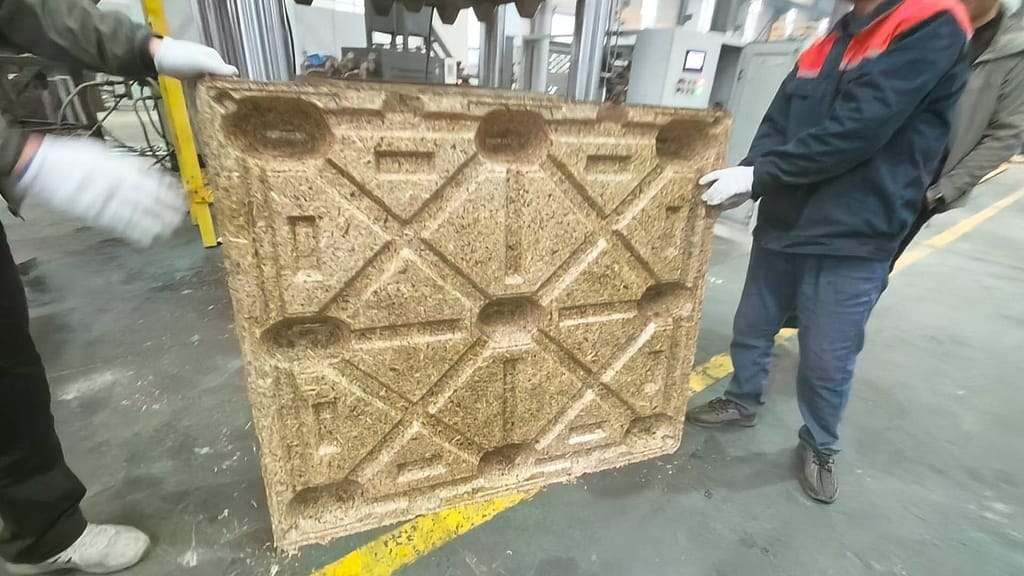
Processed wood products such as presswood and molded pallets are classified as ISPM-15 exempt. The high-temperature, high-pressure forming process (typically 150–180 °C and 15–20 MPa) kills pests and produces a uniform structure without nails. This exemption removes the fumigation or heat-treatment step that currently adds significant cost and 2–3 days per export lot for conventional pallets. Official guidance from the International Plant Protection Convention (IPPC) confirms that processed wood products fall outside the scope of ISPM 15 treatment requirements.
Why Consistency and Automation Matter More Than Ever
Buyers no longer accept dimensional variation across shifts. A dedicated steel mold plus a hydraulic press locks deck geometry, rib pattern, and foot height into every unit. Industry reference lines running 1,200–2,200-ton presses with a 180–240-second cycle can deliver roughly 12 finished pallets per hour in a fully automatic configuration once material preparation is stable. Real output is lower once downtime, first-pass yield, and fiber moisture are included — points covered in practical presswood pallet machine production capacity guides and shift-capacity calculations.
Nestability further improves economics. Industry reports, including coverage from Material Handling 24/7 on Litco’s pressed wood pallet experience, show nearly double the number of empty pallets per truckload and roughly double warehouse density compared with conventional stringer pallets. For multi-site operators this compounds quickly. Automated warehouses also benefit from the dimensional consistency of molded pallets, a topic examined in discussions of presswood pallets for AGVs and automated systems.
Feedstock Flexibility and Process Basics
Successful molded pallet production depends on controlled fiber size (typically 5–30 mm), moisture matched to the binder (UF or MDI), and uniform spreading. Common feedstocks include sawdust, wood chips, rice husk, bagasse, coconut fiber, and even reeds — materials that have been successfully tested in reed-based molded pallet trials. The same press platforms can also be configured for recycled-plastic pallets, giving plants a dual-material hedge.
Key process steps include crushing and screening, drying to target moisture, resin blending (MDI often 4–8 %, UF 10–15 %), weighing and dosing into the mold, hot pressing and demolding, and optional deburring and stacking. A complete overview of the production process of presswood pallets walks through each stage with practical parameters. Additional guidance on raw materials for pressed pallets and glue systems for molded pallet production helps operators match binder choice to end-use requirements.
Load Performance and Application Fit
Dynamic and static load ratings remain central to specification decisions. Typical Euro-size molded pallets support 1,000–2,000 kg dynamic load, with static ratings several times higher, but actual performance must be confirmed through sample testing. Detailed load-capacity references are available in the presswood pallet load capacity guide and in discussions of racking load behavior for molded pallets.
Food-industry and high-hygiene applications require extra attention to binder selection and surface cleanliness. Practical guidance on whether presswood pallets can be used in the food industry addresses moisture, odor, and regulatory considerations. For operators comparing total cost of ownership, side-by-side analyses of molded pallets versus traditional wooden pallets remain useful reference points.
Practical Considerations for New Lines
| Parameter | Typical Range | Notes |
|---|---|---|
| Press tonnage | 1,000–3,000 T | Chosen by pallet size & load |
| Cycle time | 180–240 s | Fully auto reference ~12 pcs/h |
| Finished density | 0.8–1.2 g/cm³ | Affects strength & weight |
| Dynamic load (Euro) | 1,000–2,000 kg | Confirm with sample testing |
| Nesting ratio | Up to ~4:1 | Space savings on returns |
Payback estimates vary widely with local fiber cost, labor rates, and utilization. Many operators target 12–24 months under favorable conditions. Selecting the right equipment starts with clear understanding of target output and pallet sizes; resources such as how to choose the right molded pallet press and the presswood pallet production line FAQ provide structured checklists. Product pages for presswood pallet machines and related hydraulic systems offer additional technical context for line configuration.
Looking Ahead
Regulatory pressure is unlikely to reverse. Every new interception statistic or customs amendment increases the relative value of an ISPM-15-exempt, locally produced pallet made from waste fiber. Manufacturers such as ZK Hydraulic and PalletsBiz continue to refine automation, mold designs, and biomass recipes to match this demand.
For producers evaluating a line, the critical questions are no longer only “what tonnage?” but “how stable is the fiber supply, what is real shift output after yield, and does the mold library cover the target sizes?” Answering those with trial data and capacity modeling is the fastest route to a reliable business case.


