Every pallet quotation you will ever receive is a lie by omission. Not because the supplier is dishonest, but because the sticker price answers the wrong question. The right question is this: what does one successful trip cost?

Over ten years, a plant moving 50,000 pallets a year spends $1.5 million to $4 million on pallets. Which material wins depends on the year you ask. The ranking flips twice along the way.
Total cost of ownership is the sum of every dollar a pallet generates across its working life. Purchase price. Replacement count. Repair, cleaning, loss in transit. Freight on both the loaded and the empty leg. Compliance paperwork. Disposal or recovery value at the end. Add those up, divide by successful trips, and you have cost per trip.
That is the only metric that lets a molded presswood pallet, a $70 rackable plastic pallet and a $12 stringer sit in the same comparison. Get the definition right first. The arithmetic follows, and the answer is rarely the one the sticker price suggested.
The Three Candidates, Honestly Stated
The stringer wood pallet costs $10–15 and survives 5–8 trips on a good day. Plastic pallet sellers’ own 2026 comparisons put wood at $0.50–3.00 per trip once replacements are counted. Add heat treatment for exports and it goes higher. Wood wins the purchase order and loses the decade.
The molded presswood pallet leaves the press at $8–12 per unit; market researchers put the 2026 global average selling price at $10.10–10.90. It handles one-way export duty with two or three trips of margin before it goes back into the grinder. A standard 1200×800 nine-leg unit weighs 11.5–14 kg and carries 1,000–1,500 kg dynamic. It needs no fumigation certificate anywhere on earth.
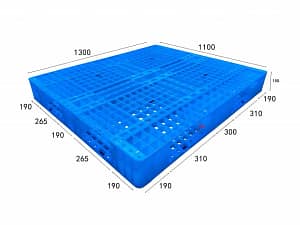
The plastic pallet costs $25–80 upfront and is rated for 250–1,000 trips. That lands at $0.08–0.35 per trip, if and only if the trips come back. That “if” is where most TCO spreadsheets go to die.
The Ten-Year Arithmetic for a One-Way Exporter
Take a mid-size exporter pushing 50,000 one-way pallets a year across borders. Nobody recovers the pallets. They are consumed at destination.
On stringer wood you buy all 50,000 annually, plus heat treatment at $2–8 per pallet per crossing. That is $500,000–750,000 in purchase price and another $100,000–400,000 in treatment. Realistic all-in: near $1.1 million a year, or about $11 million across the decade.
The plastic pallet comparison sites make this argument too. They stop one step short. Their alternative assumes the pallet comes home.
On molded presswood you also buy 50,000 units a year. At $10–12 the spend is roughly half, and treatment is zero. The weight gap helps as well: 11.5–14 kg against 18–20 kg for a hardwood stringer, on every container. End of life costs nothing, because the pallet is ground and remade rather than landfilled. All-in, expect $4.5–5.5 million over ten years. The gap against stringer wood is close to $5 million, and most of it is regulation, not material.
Where does plastic land here? Nowhere, and that is the honest answer. A 250-trip pallet in a one-way lane is a 250-trip pallet you will see once. Its cost per trip in this scenario is its purchase price: $25–80. Plastic TCO only works when recovery is engineered into the system.
The Freight and Storage Line Nobody Prices
| Two numbers belong on every plant manager’s wall. First: a truckload of standard stringer pallets runs 500–540 units, while nestable molded pallets load around 1,100. Litco International’s sales VP gave those figures in a Material Handling 24 | 7 interview. They halve your inbound pallet freight on the spot. |
Second: a 40ft high-cube container swallows 1,000–1,200 nested molded pallets against roughly 300–400 rackable injection-molded ones. Ship empty pallets anywhere and the nested format stops being an optimization. It becomes a category difference.
The same math governs the warehouse. Nestable formats take about 70% less floor space than stacked rigid pallets. Market research puts nestable designs at 52% of global molded wood pallet demand in 2026; some estimates run to 62.6%. The market already voted.
The Compliance Line Item
ISPM 15 is the quiet tax on solid wood. Heat treatment or fumigation runs $2–8 per pallet per crossing at an authorized facility. In China, a fumigation batch typically costs ¥3,000–5,000 and delays the container booking by two or three days. A single customs detention on non-compliant wood packaging commonly burns $2,000–5,000.
The enforcement environment is tightening, not easing. 2026 brought US hyphen-mark enforcement in January, EU electronic verification in August, France’s SIVEP fast-destruction policy in September, China’s GACC Order 283 in November. USDA APHIS reminds importers in plain language: noncompliant shipments will not be allowed to enter.
Molded presswood sits in the processed-wood exemption, alongside plywood and OSB. Pressed at high temperature with resin, no solid wood component, no mark to audit. Plastic is outside the standard entirely. If your lanes cross more than one border, this line item alone pays for the material decision.
The IPPC’s ISPM 15 framework and national plant protection organizations keep adding digital record-keeping and audit duties for treatment facilities. The compliant-solid-wood route gets more expensive to administer, not less.
Where Plastic Genuinely Wins
Say it plainly, because pretending otherwise costs credibility. In a closed loop with a real return rate above 60–70%, a quality plastic pallet is the cheapest option per trip. Food and pharma operations that need washdown and non-porous surfaces have few alternatives. Automated storage rewards dimensional consistency and a ten-year service life. If your pallets live in one plant or on one shuttle route, plastic deserves the premium.
Now watch what the industry itself is doing. A pallet producer serving export manufacturers increasingly runs both lines side by side. Molded presswood for the one-way export accounts. Recycled plastic molding for the closed loop. The two products serve different cost profiles rather than competing for one. Equipment makers now sell both technologies from the same floor; our own presswood pallet molding machine and plastic pallet molding machine ranges exist for exactly this reason. The hedge is the product.
The Ten-Year Ledger, Condensed
One-way export, 50,000 pallets a year, ten years:
- Stringer wood plus ISPM 15 treatment: ~$10–11 million. Highest cost, highest risk, lowest predictability. Timber prices are climbing again and enforcement keeps ratcheting.
- Molded presswood: ~$4.5–5.5 million. Half the sticker cost of the wood route. Zero treatment. Freight savings from nesting. At end of life the pallet becomes feedstock instead of waste.
- Plastic, one-way: ~$1.25–4 million per single-trip set. Disqualified by structure, not by price. A pallet rated for 250 trips and used once is a very expensive consumable.
The molded pallet market is forecast to grow from $2.46 billion in 2026 to $4.35 billion by 2034, a 7.4% CAGR. Most of that growth is exporters doing this arithmetic and walking away from treated timber. The molded wood pallets market data breaks down the segments. Nestable holds 52% of demand. Logistics and transport take 49% of consumption. Asia-Pacific is the fastest-growing region at 33% of global share.
What This Means If You Produce Pallets
If you sell pallets, the TCO gap is your sales pitch — but only if you can prove the numbers. Buyers who have done this math do not ask what the machine costs first. They ask whether their fiber can carry a load-rated pallet. That is what the CeMAT ASIA floor told us this month.
The capital equipment conversation starts after feasibility. Pattern and mold decisions follow the same cost-per-trip logic. Nestable geometry. Density held above 900 kg/m³. A line that changes size by swapping a mold instead of buying a second press.
Do the Arithmetic Yourself
Six inputs, one afternoon. Annual volume, trip profile, return rate, lane count, treatment cost, end-of-life handling. Put a number on each and the three-column comparison builds itself. Anyone who quotes you a pallet without asking for those six is selling a sticker price.
If you want a second pair of eyes on that spreadsheet, send us the six numbers. We will run the comparison against the pallet pattern we would actually quote, not a brochure range — dimensions, load rating, mold cost, lead time. Where the plastic line wins on paper, we will say so. The same goes for the wood-fiber line. More worked cost breakdowns from this series sit on our molding machine news page.