Written 12 November 2026 for packaging buyers, logistics managers and finance teams setting next year’s pallet line.
If you are building a 2027 pallet budget, three numbers now matter more than any price list: 65%, 50% and 192,963 tonnes. The first is the duty the UK proposes on out-of-quota PET and rPET. The second is the US tariff already set on Canadian PET. The third is the total UK quota that a long list of countries will share. None of them appears on a pallet quotation today. All of them will show up in landed cost somewhere in your supply chain, and the question is whether it lands on your invoice or somebody else’s.
Start with three supply paths, not three prices
Most pallet comparisons fail because they compare unit prices. A unit price is a snapshot. A budget is a three-year exposure.
Path one is buying finished pallets from a trader. Cheap on the quote, exposed on the freight and the customs code. Path two is buying recycled plastic pallets from a domestic molder. Price tracks local scrap, not import policy. Path three is pressing your own from waste you already own or can collect nearby.
Each path has a different cost curve. Path one moves with duty and freight. Path two moves with collection economics. Path three moves with your own throughput and the price of steel for the mold.
Path one: the trader route and its hidden variables
A traded pallet carries the resin’s history in its cost. If the resin crossed a border, so did a duty, a quota entry and a shipment notification.
Take the UK case seriously, because it is the most developed. The Trade Remedies Authority proposes a 65% ad valorem duty on PET and rPET above quota, with 192,963 tonnes shared across suppliers. The EU holds the largest allocation at 36,927 tonnes for the first quarter. Everyone else, China included, shares 4,827 tonnes. Once that pool empties, the next container pays 65% on arrival.
There is no alert system. There is no separate pool for recycled material. The authority explicitly refused to exempt rPET, on the grounds that recycled PET competes in the same market as virgin. Anyone who priced a 2027 contract assuming a recycling discount should re-read that paragraph twice. ZK Hydraulic’s read on the 65% UK proposal walks through the quota mechanics in more detail.
Timing is the part finance teams miss. Quota resets quarterly. The first UK period runs from December to February. A shipment booked in November for January arrival sits behind every allocation already used. Ask your supplier which quarter they are pricing, and whether they hold an allocation at all.
Path two: domestic molded pallets
A pallet molded in your region from regional waste has almost no import content. Its cost is collection, sorting, power and labor. That is a very different risk profile.
The price still moves. Scrap prices are cyclical, and a tightening bale market pushes pallet prices up within a quarter. But the movement is local and slow, and it does not depend on a quota allocation running dry in the middle of your shipping season.
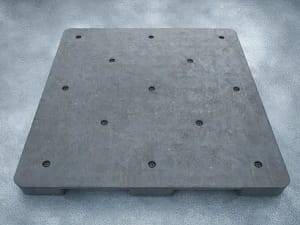
This is the path most European food and retail buyers are quietly shifting toward. It also answers the recycled-content question that shows up in tenders. A molded pallet made from post-consumer polyolefin is often 100% recycled by weight, with batch records to prove it.
Path three: pressing your own
This is the path that changes the budget line entirely. Instead of buying pallets, you buy a press and a mold, and you buy waste instead of product.
The arithmetic is not subtle. A tonne of mixed polyolefin scrap runs about ¥1,550–2,300, roughly $215–320. At 23 kg per pallet, that tonne yields about 43 pallets. Material per pallet lands near $5–7. Finished recycled pallets trade at $4.5–9.5 for light nestable designs and $15–30 for heavy-duty formats. Even in a soft resin market, the spread is wide.
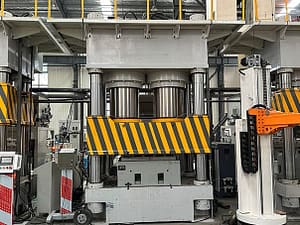
Capital is the obvious hurdle. A 1,600-ton press, mold, material handling and installation is a seven-figure investment in most currencies. The payback depends on volume, and volume depends on whether you can keep the press fed.
That feeding question is where most projects fail. A line needs 200 tonnes a month or more of consistent flake to run economically. If that material sits within 150–300 km, the project works. If it has to be trucked 800 km, the freight eats the margin before the first pallet ships.
Mold choice matters just as much. Nestable patterns cut return freight. Rackable patterns cost more steel and more weight. Our pattern library covers the common options. The plastic pallet molding machine range runs from 800 to 3,000 tons, depending on footprint and cycle target.
Run the payback on assumptions you can defend. One press at a 60-second hold makes about 55 usable pallets an hour after demolding and trim. Two shifts over 250 days is roughly 220,000 pallets a year. If molding in-house saves $8 per pallet against your current purchase price, that is $1.76 million a year before power, labor and mold amortization. Halve the saving and the case still stands. Halve the volume and it usually does not.
What to write into a 2027 tender
Three clauses do most of the work.
First, ask for landed cost, not unit price. Landed cost includes duty, freight, quota risk and the currency of the resin index. A supplier who cannot quote landed cost cannot be compared with one who can.
Second, ask for the feedstock declaration. Origin, polymer mix, recycled share, and the quality system behind it. Under EU rules taking shape this winter, a per-batch declaration of conformity is becoming the norm for recyclate entering the market as product rather than waste.
Third, ask about dimensional consistency across a production run. Automated warehouses and container loading plans both run on arithmetic. A tolerance of ±2 mm is workable. A tolerance that drifts by 5 mm across a shift is not, and it will show up as damaged goods rather than as a pallet complaint.
The short version
A pallet budget is a bet on where your material comes from. Buy from a trader and you inherit trade policy. Buy from a local molder and you inherit local scrap economics. Press your own and you inherit both the upside and the operational discipline.
Tariffs are a tax on distance. The shorter the distance between your waste and your press, the less of that tax you pay. That is the whole argument, and it holds whether the rate is 65%, 50% or zero.
If you want to test the third path with your own material, we run trial presses on customer flake before anyone commits to cavity steel. Send 50–100 kg through our contact page, and we will return pallets, load figures and a parameter sheet.